What Is a Metal Hole Punch and How Does It Work?
Metal hole punches are essential tools that create precise holes in metal; discover how they work and the various types available for your projects.
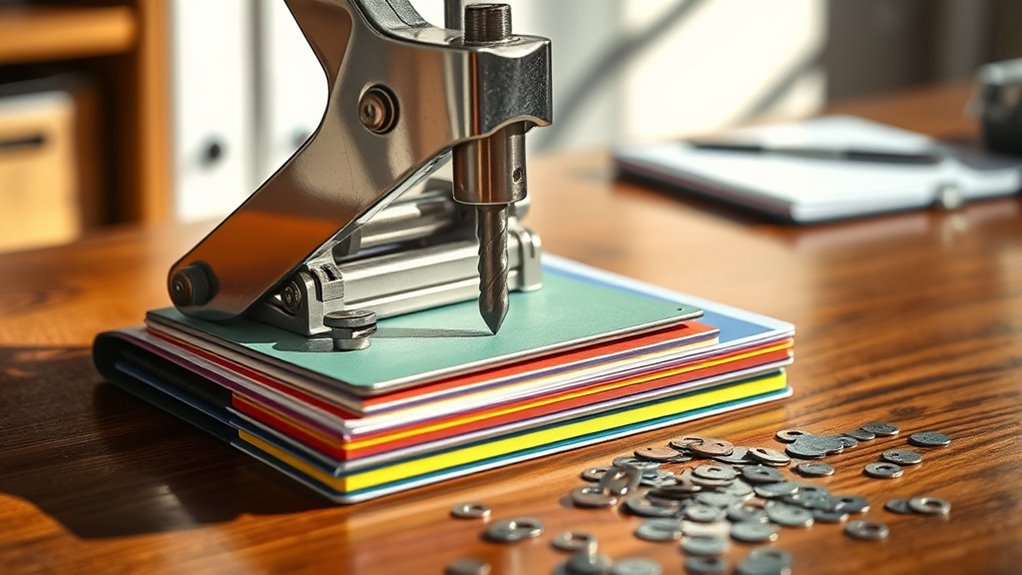
A metal hole punch is a precise tool that creates holes in metal sheets by shearing through the material with a hardened rod and a die. You position the metal between the punch and die, then apply force—manually or with machinery. The punch descends, cutting clean holes while minimizing distortion. There are various types for different applications, and knowing them can greatly enhance your projects. Explore further to discover the types and uses of each punch.
A metal hole punch is a vital tool in various industries, designed specifically to create precise holes in metal sheets and surfaces. This tool operates by shearing through the metal, employing a hardened metal rod with a shaped tip and a die for support. When you use a metal hole punch, you’re fundamentally pressing or striking the punch into the metal. The force pushes the material out, forming a clean hole while minimizing distortion.
You’ll find that there are different types of metal hole punches, each suited for specific applications. Hollow punches, for example, feature a cylindrical blade with a hollow center meant to cut out metal disks. They efficiently eject scrap through side grooves, delivering clean and quick holes. On the other hand, solid punches are solid rods and are primarily used for starting holes or driving pins, which means they’re less precise for creating clean holes. Drive punches and pin punches help in driving out pins, rivets, or bolts from assemblies without cutting holes.
You might also come across transfer punches, which help replicate hole patterns by fitting into existing holes and marking new locations. Sheet metal punches are available in various shapes, including round, oblong, square, and rectangular, allowing you to match the desired hole shape. Punch tools can create holes in materials like cardboard, plastic, and leather, extending their utility beyond just metal.
The working principle of a metal hole punch is straightforward yet effective. To start, position the metal sheet between the punch and the die. The die stabilizes the sheet while you apply force—either through manual strikes, hydraulic pressure, or pneumatic actuation. With the force applied, the punch descends and shears the metal along its tip perimeter. Depending on the punch type, the scrap slug may be ejected or fall away after cutting. The die is vital, as it guarantees smooth hole edges and minimizes any distortion of the metal. Additionally, metal hole punches are commonly used for marking holes in sheet metals to assist in precision placements.
The metal hole punch efficiently shears through material, ensuring smooth edges and minimal distortion during the cutting process.
In terms of materials and construction, punches are typically made from high carbon steel, which is hardened and tempered. This robust construction enables them to withstand the wear and tear of repeated use. If you’re working in hot environments, keeping the punches cool—such as by immersing them in cold water—helps maintain hardness. The thickness and hardness of differing metals will dictate the appropriate punch size, shape, and method of application. Industrial punch sets usually include multiple sizes to accommodate various hole diameters, with specialized options for tougher metals like stainless steel.
Metal hole punches see widespread use in metal fabrication, from creating assembly holes to decorative designs and ventilation openings. They’re pivotal in the automotive, aerospace, and construction industries for their precision and speed. For smaller jobs or on-site repairs, manual handheld punches suffice, while hydraulic and CNC-driven machines are more suitable for high-volume industrial needs.
Beyond metal, they can also tackle materials like cardboard, plastic, and leather with suitable types. Besides simply creating holes, punches can assist in driving pins and rivets, enhancing their utility in various applications.
Conclusion
In the end, who would’ve thought that a simple metal hole punch could wield such power? With its ability to create precisely spaced holes with ease, you might feel like a tool-wielding mastermind. While it seems like just a straightforward office supply, it’s actually a marvel of engineering efficiency. So, next time you need to organize your paperwork, remember that this tiny device isn’t just a hole maker; it’s a gateway to neatness and order.