How to Test If Water Conducts Electricity at Home
How to easily test if water conducts electricity at home reveals surprising results about common liquids—discover the science behind conductivity!
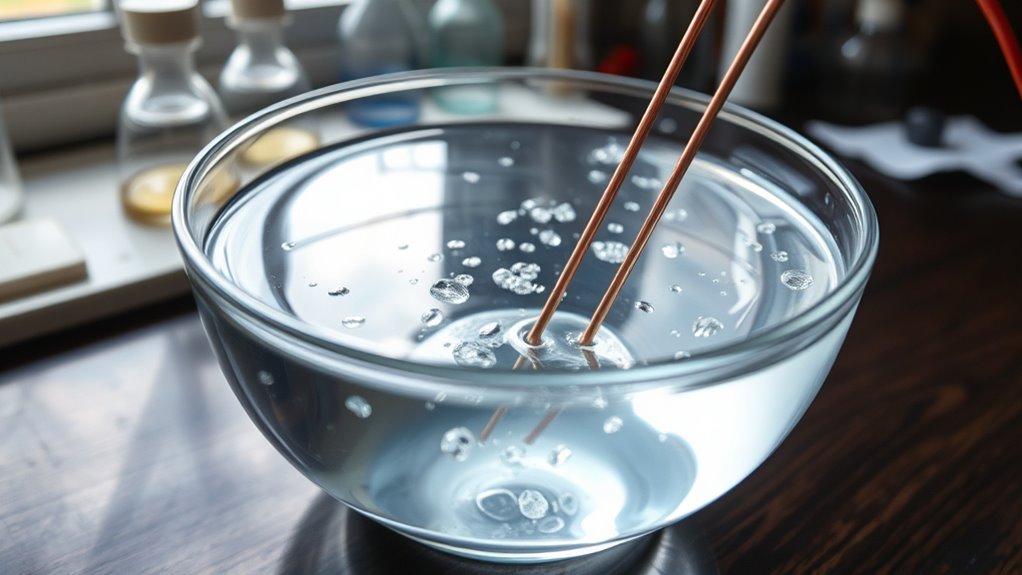
To test if water conducts electricity at home, gather a conductivity meter or a simple battery circuit, salt, and clean containers. Rinse your containers with distilled water, then fill one with pure water and another with a saltwater solution. Apply voltage through the samples. Pure water will show minimal response, while the saltwater will demonstrate significant conductivity. This experiment reveals how ion concentration affects electrical properties. If you want to explore more fascinating findings, keep going!
When you want to find out if water conducts electricity, you’re starting on an interesting experiment that can reveal a lot about its properties. Conducting this test at home can be both informative and fun. The basic idea is to use a conductivity meter, a handheld device that gives you quick and accurate readings of how well water conducts electricity, but there’s a simple way to experiment without fancy equipment too.
Exploring water’s electrical conductivity at home can be a fun and enlightening experiment.
First things first, you need to understand that water’s ability to conduct electricity relies heavily on the ions it contains. When you have pure water, it’s actually a poor conductor because it doesn’t have enough ions. However, when electrolytes dissolve in the water—like salts—you get a measurable increase in conductivity. So, for a practical experiment, gather some common table salt and water, along with a basic battery-powered device that can test for electrical flow, like a light bulb circuit or even a simple multimeter. Conductivity serves as an indirect indicator of total dissolved solids (TDS) in water quality assessment.
Before you start, verify the temperature of the water and the testing device are roughly the same. Temperature plays a vital role in conductivity readings; for the most accurate results, you should ideally conduct your tests at around 25°C. Fluctuations in temperature during the experiment can dramatically affect your results, as warmer water tends to conduct electricity better.
Next, prepare your samples. Use clean glass or plastic containers for the water. Rinse the containers with distilled water to avoid any contamination from previous substances that could skew your results. This is particularly important, as any residue left inside the container can affect your conductivity readings.
Once you’ve got your setups ready, fill one container with pure water and another with water mixed with a significant amount of salt.
Now, test each solution with your device. With a conductivity meter or your homemade circuit, you’ll apply voltage through the liquids. In pure water, you won’t see much of a reaction—the light may not even turn on or register a very low reading. But when you look at the saltwater solution, you should see a considerable change. The ions from the salt allow for the electrical current to flow through the water, displaying a high conductivity level. Conductivity is defined as conductance through a 1 cm cube of liquid, which highlights the measurement’s standardization.
Remember, the measurement you get will typically be in microsiemens (µS/cm). Drinking water usually measures between 0.5 and 1 mS/cm, while seawater can measure up to around 53 mS/cm due to its high ion content.
This experiment not only demonstrates whether water conducts electricity but also helps you grasp the relationship between ion concentration, temperature, and conductivity. With a simple setup and just a few materials, you’re well on your way to understanding the nature of water’s electrical properties. Enjoy exploring and discovering the conductivity of different water samples in your home!
Conclusion
To sum up, testing if water conducts electricity is a simple yet fascinating experiment. Did you know that pure water is actually a poor conductor, with only about 0.05 microSiemens/cm of conductivity? It’s the impurities, like salts and minerals, that improve conductivity. So, next time you pour a glass of water, remember it’s not just hydration—it’s a science experiment waiting to happen! Stay curious and keep exploring the electrical properties of everyday materials.