How to Convert 20 Ounces to Milliliters in Seconds
Discover a quick method to convert 20 ounces to milliliters effortlessly and unveil essential tips for perfect measurements that every cook and scientist should know.

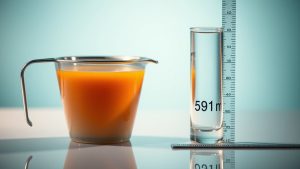
To convert 20 ounces to milliliters quickly, just multiply 20 by 29.5735. This gives you 591.47 milliliters. It’s essential to remember that this conversion applies to US fluid ounces, as imperial fluid ounces differ slightly. For even quicker mental math, you can round 1 ounce to about 30 milliliters, though it’s less precise. Stick around to discover more tips on accurate measurements and conversions for your cooking and science needs.
Converting ounces to milliliters is a straightforward task that can help you in the kitchen or when measuring liquids. When you need to convert 20 ounces to milliliters, you can rely on a simple conversion formula: multiply the number of ounces by 29.5735, the precise number of milliliters in a US fluid ounce. So, for 20 ounces, the calculation would be 20 multiplied by 29.5735, giving you 591.47 milliliters.
Knowing the difference between US fluid ounces and imperial fluid ounces is important. While 1 US fluid ounce equals approximately 29.5735 milliliters, the imperial fluid ounce is slightly smaller at about 28.41 milliliters. This difference of approximately 4% might seem minor, but it can impact recipes or scientific measurements where precision matters. Thus, when you’re converting, make sure you confirm which ounce measurement is indicated in your recipe or instructions.
Understanding the distinction between US and imperial fluid ounces is crucial for accurate measurements in cooking and science.
If you’re looking for quick and easy conversion methods, direct multiplication is often the best approach. For example, if you’re dealing with smaller quantities, you might multiply 6 ounces by 29.5735 to find it equals about 177.44 milliliters. Alternatively, you can use dimensional analysis, expressing ounces as a fraction to simplify calculations, or even employ proportional conversion using ratios to determine how many milliliters correspond to your specific number of ounces.
In everyday scenarios, rounding can make calculations faster. You might find it helpful to approximate 1 ounce to be about 30 milliliters for easier mental math, even though it introduces a slight error. Online calculators can speed up the process, providing instant conversions with complete accuracy, should you need a quick reference during cooking or recipe preparation. This utility is especially important when considering different conversion factors in weight versus fluid measurements.
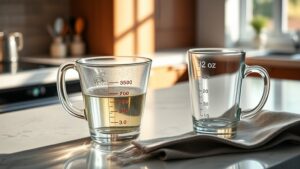
When using any conversion method, always remember the context in which you’re utilizing these measurements. For instance, fluid ounces relate to volume, while ounces by weight need density considerations for conversions, which makes things more complicated. It’s also vital to confirm you’re referencing fluid ounces, abbreviated as fl oz, versus milliliters, which can be abbreviated as ml or mL. Accurate measurements are key to ensure recipe success and safe medical dosages.
Keep in mind that if you frequently use certain measurements, it’s smart to memorize the conversion factor of 29.5735 for quick reference. Whether you’re cooking, mixing drinks, or measuring out liquid medications, utilizing conversion tables for common ounce to milliliters will save time.
For example, if you look at a conversion chart, you’ll see that 4 ounces equate to about 118.29 milliliters, 8 ounces roughly equals 236.59 milliliters, and 10 ounces converts to approximately 295.74 milliliters. These tables offer a fast reference, helping you avoid any complex calculations in the heat of the moment.
Conclusion
Now that you know how to convert 20 ounces to milliliters, it’s a breeze to handle fluid measurements! With just a simple multiplication by 29.57, you’re left with 591.47 milliliters. Isn’t it nice to have quick, accurate conversions at your fingertips? Whether you’re in the kitchen or working on a project, being able to convert easily can save you time and effort. So, what will you do with your newfound knowledge?