What Is a TDS Water Filter and How Does It Work?
Ineffective water filtration can lead to poor taste and appliance damage; discover how a TDS water filter can transform your water quality.

A TDS water filter helps reduce total dissolved solids in your water, enhancing its quality and taste. It works by employing various methods, like reverse osmosis or deionization, to effectively remove impurities and scale-causing minerals. This not only improves drinking water but also protects your plumbing from buildup. Maintaining lower TDS levels in your water is essential for both flavor and appliance longevity. Discover the different types of filtration systems to find the right one for your needs.
When you consider the quality of your drinking water, understanding Total Dissolved Solids (TDS) becomes important. TDS refers to the total concentration of dissolved substances in water, including inorganic salts like calcium and magnesium, as well as small amounts of organic matter. These components are essential because they not only affect the taste of the water you consume but also play a significant role in the longevity of your appliances. TDS is used to assess water quality and purity.
TDS originates from various sources, such as natural mineral deposits, sewage, agricultural runoff, and industrial waste, making it necessary to monitor these levels for both health and aesthetic reasons.
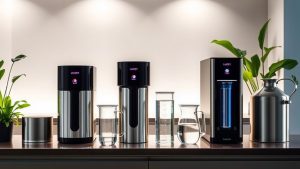
To effectively manage TDS levels, many people turn to filtration systems designed to reduce dissolved solids. One popular option is the Reverse Osmosis (RO) water filter. This system uses a semi-permeable membrane that acts as a barrier to block larger molecules and contaminants while allowing water molecules to pass through. As a result, RO systems are highly effective at removing a wide range of dissolved impurities, including harmful contaminants and excess minerals.
Reverse Osmosis filters effectively reduce dissolved solids, enhancing water quality by removing impurities and harmful contaminants.
By doing so, they not only improve the taste of your water but also protect your plumbing and appliances from scale buildup associated with high TDS levels.
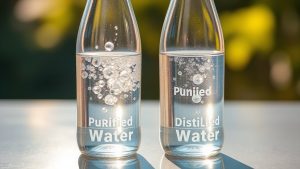
Another common method for reducing TDS is distillation, which involves boiling water to create steam and then condensing that steam back into liquid form. This process effectively separates impurities, including dissolved solids, ensuring that the water you drink isn't only safe but also free from unwanted minerals.
Deionization (DI) is yet another technique that utilizes ion exchange resins to remove cations and anions from water, further lowering TDS levels. While carbon filtration mainly targets organic compounds and particulates, it's generally less effective against dissolved solids, making it important to select a filtration system based on your specific water quality needs.
You might wonder how to determine the TDS levels in your water. TDS meters are handy tools that measure the electrical conductivity of water, offering a quick estimate of dissolved solids. However, keep in mind that these meters don't differentiate between harmful and beneficial solids, which means a thorough water test might be necessary for a complete analysis.
Professional analysis can provide insights into the specific composition of your water, helping you understand any potential health risks or taste issues.
As for suitable TDS levels, water containing between 300-500 parts per million (ppm) is generally considered ideal. This range typically offers a good balance of beneficial minerals while enhancing the overall flavor of the water.
In contrast, water with TDS levels lower than 50 ppm may taste flat, while levels exceeding 500 ppm might necessitate filtration to enhance taste and protect your appliances. The Environmental Protection Agency (EPA) recommends that drinking water systems maintain levels at or below 500 mg/L of TDS.
Conclusion
To summarize, a TDS water filter is essential for enhancing water quality by reducing total dissolved solids, ensuring safer drinking water. While some may argue that bottled water suffices, it often lacks the mineral balance that a TDS filter preserves, providing a more sustainable and cost-effective solution. By investing in a TDS filter, you're not only improving your health but also contributing to environmental sustainability, as it reduces reliance on single-use plastic bottles.