What Are Rock Tumblers and How Do They Work?
From transforming rough stones into polished gems to understanding their intricate workings, rock tumblers offer a fascinating journey into gemology. Discover how they operate!
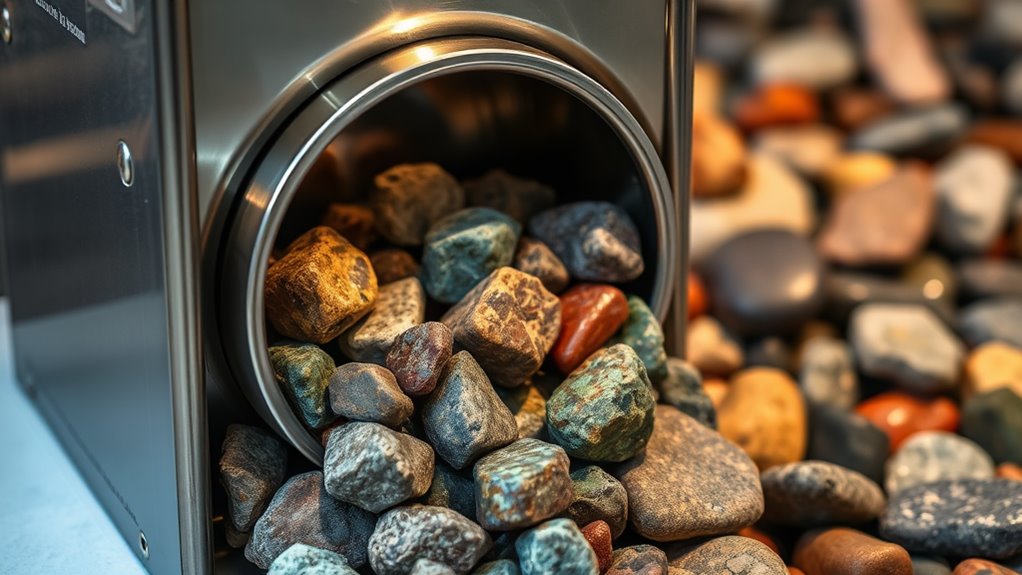
Rock tumblers are machines designed to polish rough stones into smooth, shiny gems through a systematic grinding process. You load the tumbler with rocks of similar hardness and begin with coarse silicon carbide grit. As you progress through finer grits, you must clean between stages to guarantee effective polishing. Rotary tumblers create rounded stones, while vibratory tumblers preserve original shapes. The entire process usually takes three to five weeks, and there's more to discover about their operation and materials.
Rock tumblers serve as fundamental tools for transforming rough stones into polished gems, appealing to both hobbyists and professionals alike. These machines come in two main varieties: rotary tumblers and vibratory tumblers. Each type operates on a specific principle to convert rough rock into smooth, polished stones through a series of grinding and polishing stages, making them indispensable in the creation of decorative stones or jewelry components.
Rock tumblers are essential for transforming rough stones into polished gems, ideal for both hobbyists and professionals.
When you start the tumbling process, the initial preparation is essential. First, select rocks of similar hardness to prevent any damage during tumbling. Once you've chosen your rocks, the coarse grinding stage begins. Using coarse grit, typically 60/90 silicon carbide, you shape the stones. This initial phase is important for forming the basic contours of the stones. Ideal materials have a Mohs hardness between 6 and 7 to ensure effective tumbling and prevent any scratching.
After about seven days of grinding, you'll move to the intermediate steps, employing finer grits—ranging from 120-220 to 400-600 mesh—to smooth the stones further. Each step requires careful attention and cleaning between stages to remove any residual grit, ensuring that the next stage can effectively refine the stones.
Loading the tumbler barrel correctly is also fundamental. You should fill it about half to two-thirds full with your selected rocks. A mix of rock sizes enhances the efficiency of grinding. For every pound of rock, add approximately two tablespoons of grit and sufficient water to cover the rocks.
Once you've sealed the barrel, operate the tumbler according to the manufacturer's instructions, paying attention to the type of tumbler you're using. Rotary tumblers, which are quieter and generally less expensive, rotate at a constant speed, producing rounded stones. In contrast, vibratory tumblers use rapid vibrations to preserve the original shapes of the stones and are typically preferred for more professional results.
The duration of the tumbling process varies based on rock hardness and the desired finish. The initial coarse grinding stage usually lasts about seven days, but the full polishing process typically spans three to five weeks. The condition of the starting material and the type of finish you want will greatly affect this timeline.
For instance, the final polishing step may require additional days depending on whether you're using cerium oxide or tin oxide as your polishing powder.
Safety considerations are also paramount when using rock tumblers. Always wear safety glasses when handling rocks or working with open tumblers. Additionally, understanding the materials you'll use is crucial. Silicon carbide grit is perfect for initial shaping, while aluminum oxide grit is great for finer smoothing.
Polishing powders like cerium or tin oxide provide the finishing touch, and water acts as a lubricant during the entire process. Using ceramic media as filler can also help cushion the stones, preventing damage during tumbling.
Conclusion
To sum up, rock tumblers are fascinating devices that transform rough stones into polished gems through a meticulous grinding process. You might think the wait for results is too long, but consider the beauty that emerges after weeks of patience. Each stage reveals a deeper brilliance, much like personal growth. Embrace the journey; every turn brings you closer to something extraordinary. Investing time in this craft not only yields stunning stones but also cultivates a rewarding sense of achievement.