How Much Does a Gallon of Water Weigh?
Not all gallons of water are created equal; discover the surprising factors that influence their weight and why it matters.

A gallon of water weighs about 8.34 pounds (3.78 kilograms) at room temperature. This weight can vary slightly based on temperature, with colder water weighing a bit more due to increased density. For example, at its densest point at 39.2°F, a gallon weighs around 8.345 pounds. Understanding the weight of water is essential for various applications, from irrigation to logistics. There’s plenty more to discover about liquid weights and their implications.
When you measure a gallon of water, it weighs approximately 8.34 pounds, or 3.78 kilograms, at room temperature (around 68°F or 20°C). This weight corresponds to a volume of 128 fluid ounces or 3.785 liters. The density of pure water at the ideal temperature of 4°C (39.2°F) is about 1 gram per cubic centimeter, which supports this weight figure. Although this 8.34-pound standard is widely accepted for practical calculations in various fields ranging from science to daily life, the weight can slightly vary based on factors like temperature and purity, along with some differences between the U.S. and Imperial gallon.
You should note that the temperature of the water noticeably influences its weight. As water heats up, its density decreases, causing a gallon to weigh slightly less at higher temperatures. Conversely, when the water is colder, the weight is marginally greater. At 39.2°F, water is at its densest, making a gallon weigh about 8.345 pounds. By the time the temperature reaches around 68°F to 77°F, the weight drops a bit to 8.32 to 8.34 pounds. Essentially, if you observe fluctuations in environmental conditions, you might see changes of a few hundredths of a pound per gallon.
Gravity alters the weight of water based on planetary mass, further illustrating how environmental factors influence measurements.
Understanding the relationship between volume and weight is also important. To calculate the weight in pounds, you simply multiply the volume in gallons by the weight per gallon (around 8.345 pounds). For instance, if you measure out 5 gallons of water, it’ll weigh approximately 41.73 pounds (5 gallons multiplied by 8.345 pounds). This straightforward relationship aids rapid weight estimations across different applications including irrigation, aquariums, and domestic use.
While it’s convenient to assume density remains constant for water under standard conditions, keep in mind that this may vary with other substances. Salty water is heavier due to dissolved substances, weighing around 8.6 pounds per gallon.
When comparing water’s weight to that of other common liquids, you’ll find notable differences. For example, a gallon of milk weighs slightly more at approximately 8.637 pounds, whereas honey is even denser, weighing about 11.85 pounds per gallon. On the other end of the spectrum, jet fuel weighs around 6.71 pounds per gallon. Such variations create a framework where water serves as a benchmark for liquid weight conversions.
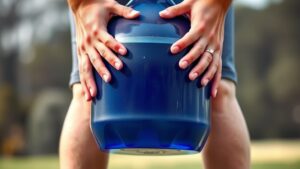
Practical scenarios illustrating this concept abound. A standard 5-gallon water jug sums up to around 41.7 pounds, indicating considerable lifting weight. If you consider a 10-gallon aquarium filled entirely with water, you’re looking at approximately 83.4 pounds. Handling 100 gallons amounts to a considerable 834 pounds, especially notable for industries in farming or irrigation.
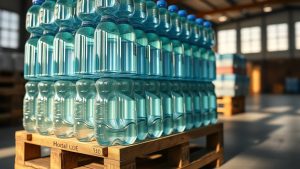
When you account for bottled water, the weight of the container adds approximately 1.1 pounds per 16.9 fluid ounce bottle. These mathematical relationships are critical in logistics, construction, and scientific measurements where accurate liquid weight is necessary.
Conclusion
To summarize, you’ve learned that a gallon of water weighs about 8.34 pounds at 62°F. This weight can fluctuate slightly with temperature changes, as water expands when heated, becoming less dense. Notably, at its maximum density around 39°F, a gallon weighs about 8.35 pounds. Understanding these nuances not only helps in practical applications, like cooking or science experiments, but also illustrates the fascinating properties of water as an essential resource in our daily lives.