How Many Water Bottles Make a Gallon?
Unlock the secrets of hydration by discovering how many water bottles equal a gallon and the best sizes to stay refreshed throughout your day.
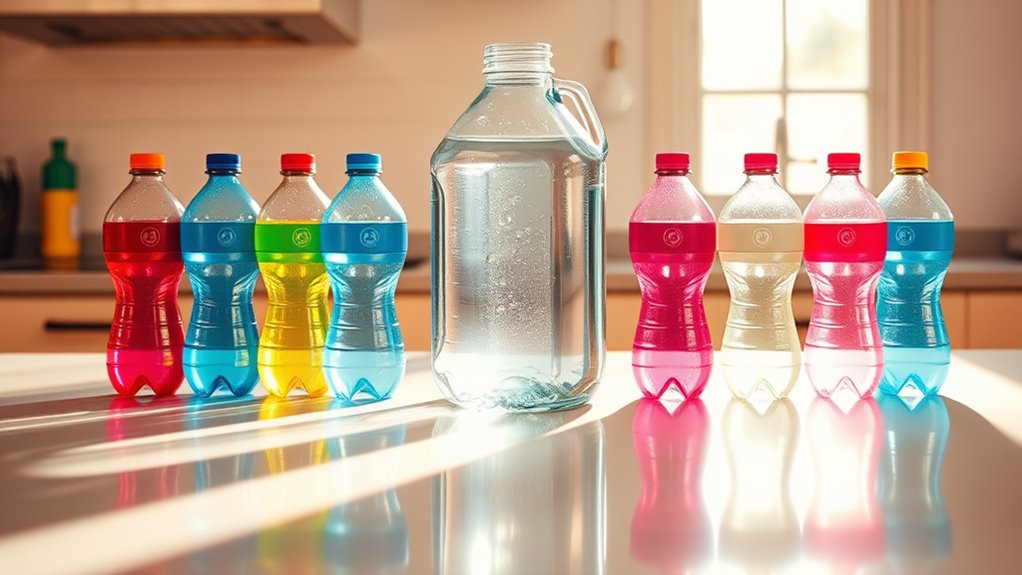
A gallon holds 128 fluid ounces, so how many water bottles you'll need depends on their size. For example, 16 eight-ounce bottles make a gallon, while 11 twelve-ounce bottles work too. If you prefer larger sizes, just know that about 8 bottles of 16.9 ounces and 7 bottles of 20 ounces will fit in a gallon. Understanding your bottle size helps you stay hydrated effectively. Keep exploring to find out more about daily hydration needs!
When you're trying to determine how many water bottles make up a gallon, it's essential to know that a gallon contains 128 fluid ounces in the US Customary system. This knowledge sets the stage for calculating how many bottles you'll need based on the size of each bottle. The formula you'll use is simple: divide the total ounces in a gallon by the ounces in each bottle. This straightforward calculation reveals the number of bottles necessary to equal a gallon.
To find out how many water bottles equal a gallon, remember that a gallon is 128 fluid ounces.
Standard water bottle sizes typically range from 8 ounces to 30 ounces. If you choose to use 8-ounce bottles, you'd need 16 of them to make a gallon since 128 divided by 8 equals 16. If you opt for 12-ounce bottles, you'd require approximately 10.67 bottles, meaning you'd need 11 bottles to meet or exceed a gallon. With 16.9-ounce bottles, you'd need about 7.57 bottles, rounding up to 8 for convenience. For 20-ounce bottles, 6.4 bottles are required, rounding to 7, while 24-ounce bottles require about 5.33, which rounds to 6 bottles. This variation in bottle size markedly affects how many you'll need to reach a gallon.
Understanding these calculations can help you manage your daily water intake effectively. The National Academies recommend that men consume around 125 ounces and women about 91 ounces daily. Since a gallon is 128 ounces, it surpasses these recommendations, providing ample hydration for your daily needs. Knowing the specific system for measurements is fundamental for various bodily functions, including digestion and temperature regulation. It can even aid in weight management by promoting feelings of fullness and boosting metabolism.
It's important to track your water intake, especially if you're active or have specific health goals. Monitoring your hydration can prevent issues like headaches and kidney stones, which are often linked to inadequate fluid intake. Using standard bottle sizes, like the common 16.9-ounce bottle, can help you easily keep track of how much water you're drinking throughout the day. Reusable bottles are another practical option, as they're not only eco-friendly but also encourage you to drink more water.
Adjusting your water intake based on your activity level and the climate is also important. For a general guideline, consider drinking half your body weight in ounces. This personalized approach guarantees you're meeting your hydration needs effectively.
Always remember that the gallon-to-ounces conversion—multiplying by 128—is specific to the US Customary system, while other systems, like the British Imperial, differ.
Conclusion
To summarize, while a standard water bottle holds 16.9 ounces, you'll need about 7.5 bottles to make a gallon. This juxtaposition of convenience versus necessity highlights how easily we can overlook the volume we consume daily. On one hand, a single bottle seems manageable, yet collectively, they represent a significant amount of hydration. Understanding this relationship not only informs your drinking habits but also encourages mindful consumption, ensuring you stay properly hydrated while respecting the environment.