What Is a Whole House RO System and How Does It Function?
Find out how a whole house RO system purifies water throughout your home, ensuring safety and quality—discover its components and installation next.
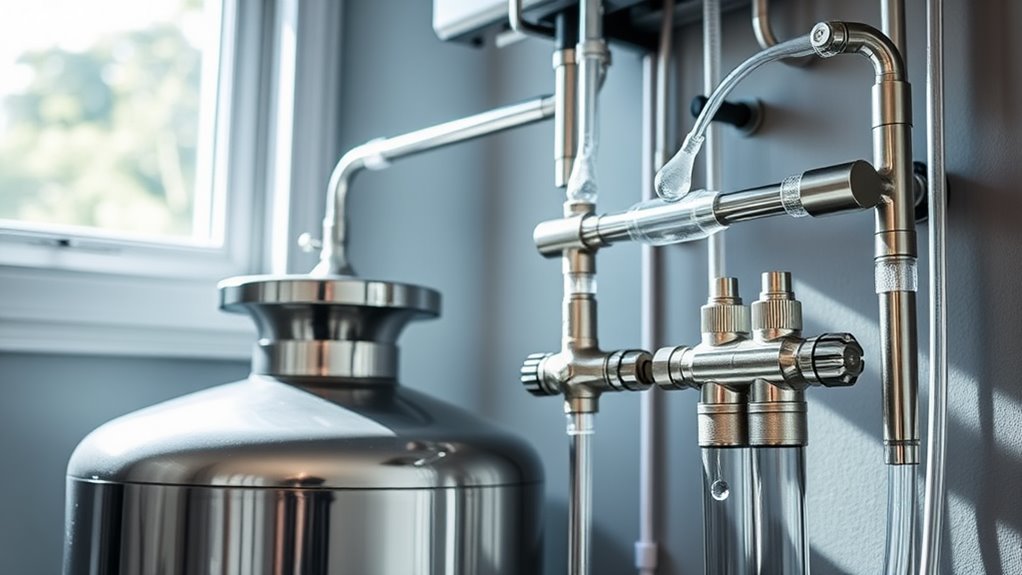
A whole-house reverse osmosis (RO) system purifies all the water entering your home, ensuring it's free from contaminants. It works by using heavy-duty pumps and pre-treatment filters to protect the RO membranes. Water undergoes reverse osmosis to remove dissolved solids and heavy metals, providing high-quality water for various uses. While the initial cost and maintenance needs can be significant, the benefits are substantial. You'll find out more about its components and installation next.
When you consider the quality of water flowing into your home, a whole-house reverse osmosis (RO) system emerges as a robust solution that guarantees every drop is purified. This extensive water filtration system is installed at the point where water enters your home, making certain that all incoming water is treated uniformly. Unlike localized filtration solutions, a whole-house RO system filters water for every tap and appliance, delivering consistently high-quality water throughout your household.
The functionality of a whole-house RO system hinges on its components, which include heavy-duty pumps, pre-treatment filters, storage tanks, and distribution systems. Heavy-duty pumps are essential, as they manage water pressure fluctuations, maintaining a steady flow even during peak usage times. The pre-treatment filters play an important role in protecting the RO membranes by removing large particles and sediment that could potentially harm the system. Pre-filters are critical in this process, as they remove sediment, chlorine, and large particles from the water before it reaches the RO membrane.
Additionally, antiscalant systems are often preferred over traditional water softeners due to their cost-effectiveness and salt-free operation, further enhancing the system's efficiency.
Once pre-treated, the water undergoes reverse osmosis, a process that effectively removes dissolved solids, heavy metals, and other impurities. This technology is versatile, making it suitable for treating both groundwater and municipal supplies that may contain a range of contaminants. The system's distribution network guarantees that treated water reaches every faucet and appliance, providing you with the convenience of having purified water available wherever you need it.
Installation of a whole-house RO system requires professional expertise due to its complexity. A qualified technician will take into account the varying water pressures throughout your home and the space needed for system components. While the initial cost may be higher than localized systems, the benefits of thorough filtration make it a worthwhile investment.
Regular maintenance is also essential to maintain peak performance over time, which includes monitoring the condition of the pre-treatment filters and RO membranes.
Despite its advantages, a whole-house RO system does come with challenges. The upfront cost can be significant, and the system generates wastewater as a byproduct of the filtration process. Additionally, the energy consumption may be higher due to the operation of the pumps, which is a consideration for energy-conscious homeowners.
Space constraints can also pose a challenge, as the system requires a designated area for installation.
Conclusion
To sum up, a whole house RO system acts as a guardian for your water supply, filtering out impurities and providing you with clean, revitalizing water at every tap. Think of it as a shield, protecting your home from contaminants while enhancing your family's health. By investing in this system, you're ensuring that every drop you drink, cook with, or bathe in is pure and safe. Embrace the peace of mind that comes with knowing your water is thoroughly purified.