What Is a DI Water System and How Does It Function?
See how a DI water system transforms ordinary water into ultra-pure quality, and discover the crucial processes behind its remarkable efficiency.

A DI water system produces ultra-pure water by removing nearly all ions and contaminants through an ion exchange process. It uses specialized resins to replace positive ions with hydrogen and negative ions with hydroxide. These systems often integrate reverse osmosis for enhanced performance, markedly reducing impurities. Regular maintenance and monitoring guarantee the water meets strict specifications. Understanding how these components function is key to maximizing efficiency and effectiveness in your applications.
Deionized (DI) water systems play an important role in various industries by providing water that's free from most ions and minerals, guaranteeing the highest purity levels for sensitive applications. You'll find DI water systems in medical offices, laboratories, pharmaceuticals, and electronics manufacturing, where even the smallest contaminants can impact results.
DI water systems ensure the highest purity levels, essential for sensitive applications in industries like healthcare and electronics.
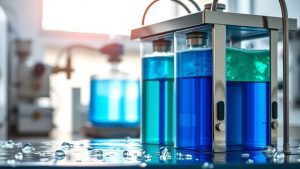
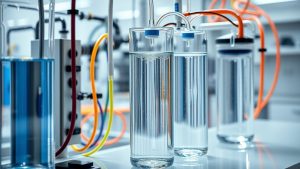
These systems typically consist of DI tanks made from fiberglass, which may work in conjunction with other treatment methods like reverse osmosis (RO) or UV sterilization to improve water quality.
At the heart of a DI water system is the ion exchange process, which utilizes ion exchange resins. These resins serve as the primary mechanism for removing ions from the water. Cation resins attract positive ions, while anion resins target negative ions, effectively stripping the water of impurities. Ions are electrically charged atoms or molecules, and their removal is essential for achieving high purity levels.
The resins come in various types, including strong acid cation (SAC), strong base anion (SBA), weak acid cation (WAC), and weak base anion (WBA). As water flows through these resins, positively charged cations are replaced with hydrogen (H+), and negatively charged anions are replaced with hydroxide (OH-). However, keep in mind that the resin's capacity is finite, requiring periodic regeneration to maintain effectiveness.
You can configure DI systems in either dual bed or mixed bed formats. Dual bed systems utilize separate tanks for cation and anion resins, necessitating a sequential processing approach. In contrast, mixed bed systems intermix SAC and SBA resins, enabling more efficient ion exchange and achieving higher water purity levels.
Mixed bed systems can even minimize sodium leakage issues often associated with dual bed systems. When fine-tuned, these systems can achieve up to 18.2 megohm resistivity for Type I DI water, meeting stringent quality standards.
Integrating reverse osmosis into your DI water system can greatly enhance performance. RO removes up to 99% of dissolved solids before the DI treatment stage, effectively reducing the load on DI tanks and increasing their run time.
While RO systems require higher initial investments and ongoing maintenance, they can prove cost-effective in the long run by extending the life of your DI tanks. However, be aware that RO systems generate brine waste, which must be managed responsibly.
Regular maintenance and regeneration of the ion exchange resins are vital for peak functionality. Cation resins are typically regenerated using hydrochloric acid, while anion resins use sodium hydroxide.
When the ion exchange capacity of your DI tanks is depleted, you'll need to replace them to maintain continued water quality. Some facilities maintain standby tanks to avoid supply interruptions, while quality monitoring systems are indispensable for confirming that water meets required specifications.
In applications such as laboratories and electronics manufacturing, the role of DI water can't be overstated. Its purity is critical for minimizing interference in experiments and preventing damage in sensitive electronic components.
Understanding how a DI water system functions empowers you to implement it effectively, guaranteeing that you maintain the high standards required for your industry.
Conclusion
In principle, a DI water system acts as a meticulous filter, akin to a gardener tending to delicate plants by removing impurities from the soil. By utilizing ion exchange processes, it guarantees that the water you use is free of contaminants, making it ideal for laboratory, industrial, and medical applications. Understanding how this system operates empowers you to appreciate its crucial role in achieving the highest water purity standards, safeguarding both processes and results in your work.