What Is Carbon Filter Water and How Does It Work?
Breathe new life into your drinking water with carbon filters—discover how they work and what they really remove for optimal purification.
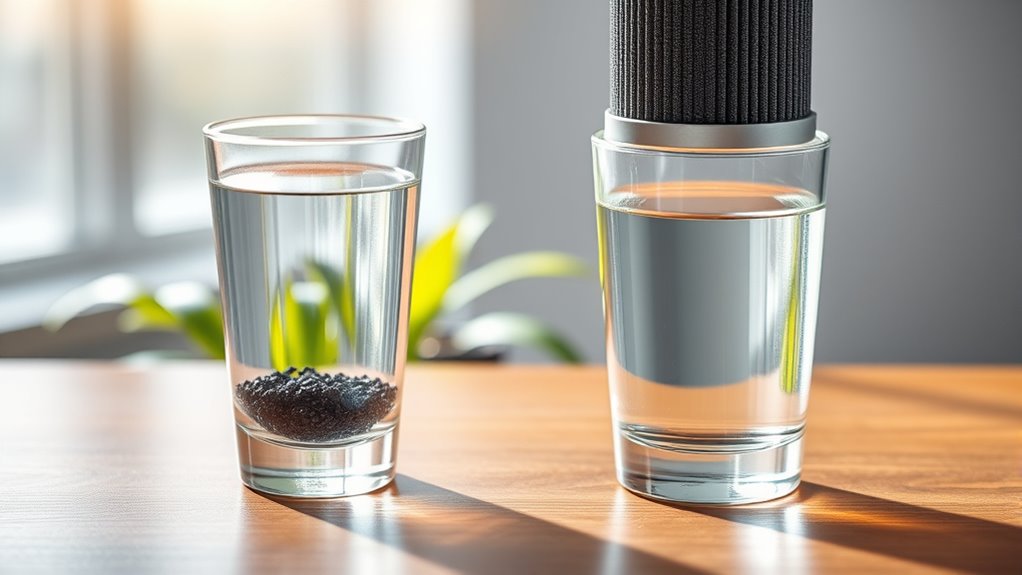
Carbon filter water is a purification process that uses activated carbon to enhance drinking water quality. The activated carbon’s porous structure adsorbs contaminants like chlorine, volatile organic compounds, and certain harmful substances, improving taste and odor. However, it doesn’t remove minerals or heavy metals. Regular maintenance is essential for efficiency, as performance can decline over time. Discovering more about the types of carbon filters and their specific uses can help optimize your water purification choices.
Carbon filter water represents a notable advancement in water purification technologies, effectively enhancing the quality of drinking water. When water flows through a filtration system containing activated carbon, it undergoes a transformation that considerably improves its taste, odor, and clarity by removing various contaminants. This advanced filtration process is vital for households, commercial establishments, and industrial applications, providing a reliable method for producing cleaner drinking water.
Activated carbon, the key component of carbon filters, is processed to create a highly porous structure, which is essential for its function. The main principle at play here is adsorption, where contaminants cling to the surface of the carbon material. As water traverses through the filter, these impurities become trapped within the carbon’s extensive network of pores. The overall effectiveness of this process hinges on factors like the surface area of the carbon, contact time with the water, and the design of the filter itself. A gram of activated carbon can possess a surface area up to 1,400 square meters, significantly enhancing adsorption capacity. Additionally, carbon filters are commonly used for treating well water to reduce unpleasant odors and contaminants.
While carbon filters excel at removing chlorine, volatile organic compounds (VOCs), pesticides, and some pharmaceuticals, they fall short in eliminating dissolved inorganic compounds, heavy metals, and microorganisms.
You can find various types of carbon filters tailored to different needs. Granular Activated Carbon (GAC) filters utilize loose particles, allowing for higher flow rates but potentially sacrificing efficiency in contaminant removal. Alternatively, carbon block filters compress powdered activated carbon into a dense block, leading to slower flow rates but enhanced contaminant filtration. Extruded Activated Carbon (EAC) filters, similar to carbon block units, are well-suited for under-sink applications requiring even greater efficiency.
For everyday use, GAC filters are common in pitcher and refrigerator systems, while carbon block filters are often the choice for thorough contaminant reduction.
Carbon filters effectively tackle specific contaminants, greatly improving the quality of water. Chlorine and chloramines are efficiently removed, leading to better taste and odor profiles. VOCs, including benzene and toluene, along with various pesticides and herbicides, are adsorbed and diminished. Carbon filters even manage to capture certain harmful substances like trihalomethanes (THMs) and PFAS, which can pose health risks if present in drinking water.
However, the performance of carbon filters isn’t uniform; it depends on several factors. The surface area of activated carbon can reach up to 1,400 square meters per gram, enhancing its adsorption capacity. Additionally, longer water contact times improve contaminant removal rates, while slower flow rates increase adsorption efficiency. The design of the filter plays a vital role as well, with carbon block models providing enhanced contact time compared to GAC filters. Pre-filtration through sediment filters can further prolong the lifespan and effectiveness of carbon filters.
While carbon filter water represents a remarkable achievement in purification technology, it’s important to acknowledge their limitations. They can’t remove dissolved minerals or heavy metals, nor do they tackle microorganisms. For maximum performance and water quality, regular maintenance and an understanding of these limitations are crucial in achieving the best results in your water purification efforts.
Conclusion
So, you’ve got yourself a carbon filter and think you’re now an expert on hydration? Congratulations! With its ability to trap impurities and make your water taste like it actually came from a pristine mountain spring, you’re just a step away from sipping like a true connoisseur. Just remember, while carbon filters do wonders, they can’t turn your tap water into fine wine—though for some of us, it might be the next best thing! Stay thirsty, my refined friend!