Hormonal Hijack: The Endocrine Disruptors Hiding in Your Plastic Water Bottle
Understanding the “Lock and Key” problem of Endocrine Disruptors
Our bodies are governed by one of the most complex communication networks ever designed: the endocrine system. If we were to describe it in computer science terms, the endocrine system is an elaborate “Internet of Things” (IoT) for the human body. It uses chemical signals—hormones—to transmit instructions from the brain to every organ, regulating everything from metabolism and growth to mood and sleep.
However, modern life has introduced a “glitch” into this system. Endocrine Disrupting Chemicals (EDCs), often found in everyday plastics, act as biological hackers. They don’t simply break the system; they perform a man-in-the-middle attack, impersonating our natural signals and sending false instructions to our cells.

Molecular Mimicry: The Estrogen Impersonator
To understand how a plastic bottle can affect your biology, we must look at the “Lock and Key” mechanism. In a healthy body, a hormone (the key) fits perfectly into a specific receptor (the lock) on a cell. When the key turns, the cell performs a specific action, such as burning fat or building muscle.
Molecular mimicry occurs when a foreign chemical, such as a Phthalate or Bisphenol, has a three-dimensional structure that “looks” enough like a natural hormone to fool the receptor.
The Competitive Inhibition Problem
Most EDCs share a structural similarity with 17β-estradiol, the primary human estrogen. When these micro-pollutants enter your bloodstream—leached from a plastic bottle exposed to heat (as discussed in our post on molecular leaching)—they occupy the receptor sites.
This creates two distinct problems:
Agonism: The chemical “fake key” fits well enough to turn the lock, sending a signal for the cell to act as if estrogen levels are high, even when they aren’t.
Antagonism: The fake key fits but doesn’t turn. However, it stays in the lock, preventing the body’s real hormones from entering. This effectively “mutes” your natural biological communication.
The Low-Dose Paradox: Why “Trace Amounts” Matter
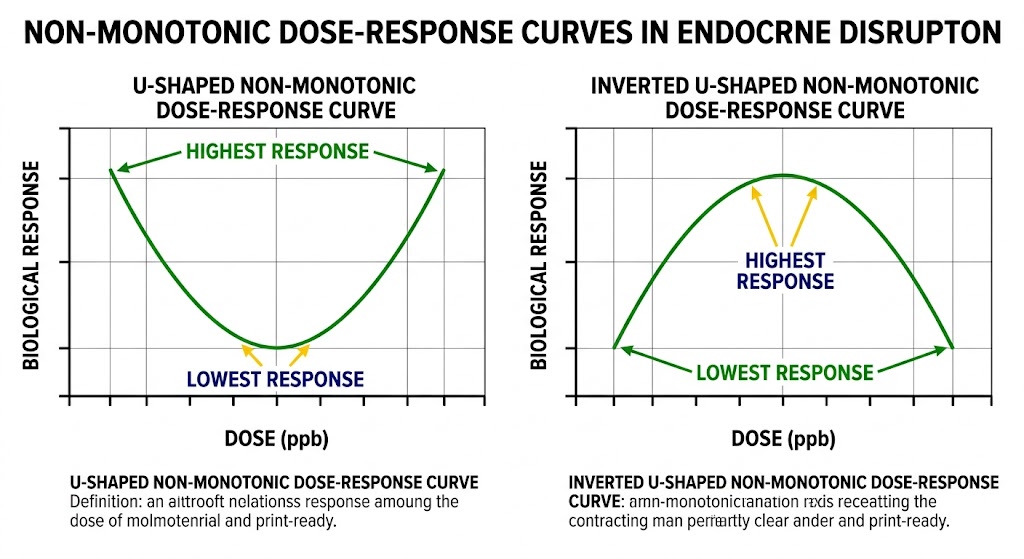
In toxicology, the old rule was “the dose makes the poison.” But EDCs don’t follow this rule. Research by Vandenberg et al. (2012) has shown that these chemicals exhibit non-monotonic dose responses.
This means that very small amounts—micro-pollutants—can sometimes cause more disruption than large doses. Why? Because the endocrine system is designed to respond to tiny concentrations of hormones. Our receptors are hyper-sensitive. By introducing even parts-per-billion (ppb) of plastic additives, we are shouting into a system that was designed to hear a whisper.
The Obesogen Effect: Plastics and Metabolism
One of the most concerning areas of endocrine research is the link between plastics and weight gain. Scientists have coined the term “Obesogens” to describe chemicals like Phthalates that interfere with lipid metabolism.
How EDCs Alter Fat Storage
When EDCs bind to receptors like the PPARγ (Peroxisome Proliferator-Activated Receptor gamma), they can actually program stem cells to become fat cells instead of bone or muscle cells.
They increase the number of fat cells (adipocytes).
They increase the amount of fat stored in each cell.
They lower the metabolic rate, making it harder to burn energy.
If you are struggling with energy levels or unexpected weight fluctuations despite a healthy diet, the “chemical soup” leaching from your daily plastic bottle might be a hidden variable in your biological equation.
The Neuro-Endocrine Axis: Brain Health and “Hormonal Fog”
For students and professionals, the most immediate impact of endocrine disruption is often felt in cognitive performance. The hypothalamus and the pituitary gland act as the “CPU” of your hormonal system.
According to the Endocrine Society (2015), EDCs can cross the blood-brain barrier and interfere with the neuro-endocrine axis. This interference can manifest as:
Cognitive Fog: A lack of mental clarity and difficulty focusing.
Sleep Disruption: Interference with melatonin production.
Thyroid Interference: Additives in plastic can block the transport of iodine, leading to sub-optimal thyroid function, which is the primary driver of your daily energy.
The Student Perspective: Hydration Without the Hack
As a student spending 8 to 10 hours a day analyzing data or preparing for exams, your brain requires peak efficiency. Hydration is key to cognitive function, but the delivery system of that water matters just as much as the water itself.
When you drink from a disposable plastic bottle, you aren’t just getting $H_2O$. You are potentially introducing a library of “biological hackers” that compete with your natural hormones for control of your system.
The Stainless Steel Advantage
Choosing a stainless steel H2GO bottle is a data-driven decision for your health. Stainless steel (specifically 18/8 food-grade) is an inert material. It does not possess a “molecular key” that can fit into your hormonal locks.
Zero Leaching: Unlike the PET bottles analyzed in our science of leaching guide, steel maintains its structural integrity at high temperatures.
Zero Mimicry: There are no phthalates or bisphenols to “hack” your estrogen receptors.
Pure Hydration: Your endocrine system remains a closed, secure network, free from external interference.
Conclusion: Securing Your Biological Network
We live in a world where plastic is unavoidable, but our primary source of hydration shouldn’t be a source of biological stress. Understanding the “Lock and Key” problem allows us to see that endocrine disruption is not an invisible myth—it is a measurable chemical interaction.
By switching to inert materials like stainless steel or glass, you are effectively installing a “firewall” for your endocrine system. You are ensuring that your body’s communication network remains clear, your metabolism stays on track, and your brain remains free from the hormonal fog of micro-pollutants.
The evidence is clear: while we may not be able to change the global plastic crisis overnight, we can choose to stop the “hormonal hijack” in our own lives, one bottle at a time.
References
Gore, A. C., et al. (2015). EDC-2: The Endocrine Society’s Second Scientific Statement on Endocrine-Disrupting Chemicals. Endocrine Reviews. This landmark study provides the most comprehensive look at how plastic additives act as “biological impersonators.”
Vandenberg, L. N., et al. (2012). Hormones and Endocrine-Disrupting Chemicals: Low-Dose Effects and Nonmonotonic Dose Responses. Endocrine Reviews. Essential reading for understanding why even “safe” trace levels of chemicals can be biologically active.
Nerín, C., et al. (2013). The challenge of identifying non-intentionally added substances (NIAS) in food packaging.Analytica Chimica Acta.