What Is a DI Water System and How Does It Work?
Outlining the DI water system’s unique ion exchange process reveals its critical role in producing ultra-pure water; discover the fascinating details behind its functionality!
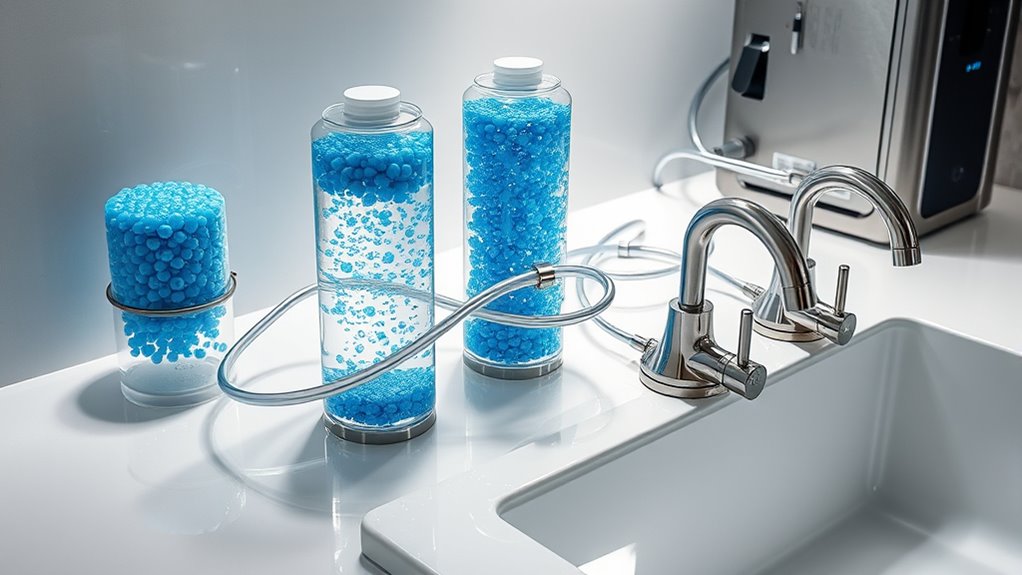
A DI water system produces ultra-pure water by using an ion exchange process. It removes charged ions like calcium and sodium, replacing them with hydrogen and hydroxyl ions. Water first flows through a cation resin column, followed by an anion resin column. There are two configurations: two-bed and mixed-bed, with mixed-bed typically offering superior purity. Regular resin regeneration with hydrochloric acid and sodium hydroxide maintains efficiency. You’ll find more intriguing details about its functions and applications as you explore further.
DI Water System
A deionized (DI) water system effectively removes charged ions from water, ensuring ultra-high purity for various applications. The process relies on ion exchange methods that target both positively charged ions, known as cations, and negatively charged ions, referred to as anions.
In a typical configuration, cations like calcium, sodium, and magnesium are exchanged for hydrogen ions (H+), while anions such as chlorides, sulfates, and nitrates are exchanged for hydroxyl ions (OH-). As these ions are replaced through this precise interaction, they combine to produce pure H2O, achieving the desired level of purity.
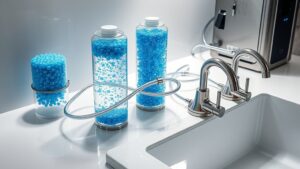
Two common configurations for DI systems are the two-bed and mixed-bed setups. In the two-bed configuration, you’ll find separate vessels: one containing cation-exchange resin and the other filled with anion-exchange resin.
When water enters, it first flows through the cation column, where all cations are replaced with hydrogen ions. Monovalent cations like sodium are replaced by a single hydrogen ion, while divalent cations, such as calcium, require two hydrogen ions to maintain electrical balance. After this stage, the water continues into the anion column, where hydroxide ions replace negatively charged ions, culminating in deionized water.
On the other hand, the mixed-bed configuration presents the two types of resin in a single pressure vessel, effectively mixing the resins for simultaneous ion exchange. This integrated approach yields an output quality that often surpasses that of a two-bed system.
You’ll notice that mixed-bed systems may serve as polishing stages following initial deionization, enhancing the overall effectiveness while also reducing the space required for installation.
As you operate these systems, keep in mind the importance of resin regeneration. Over time, both cation and anion resins become saturated with unwanted ions. For cation resin, you’ll use hydrochloric acid (HCl) to restore hydrogen ions during the regeneration process.
For anion resin, sodium hydroxide (NaOH) serves a similar purpose by reintroducing hydroxyl ions. It’s essential to perform periodic regeneration to prepare resin beads for repeated cycles of ion exchange, ensuring consistent performance and quality.
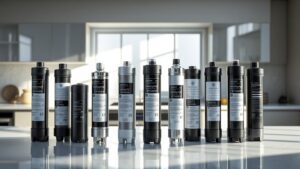
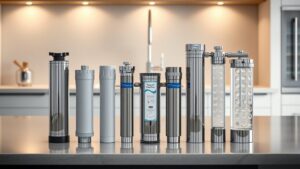
DI systems comprise various components, often including tanks or cartridges housing the resins tailored to your particular needs. Depending on the application, you might incorporate additional features, such as reverse osmosis systems or monitoring equipment, to enhance purification standards.
In ultra-high purity scenarios, recirculation loops, pumps, and UV sterilization play significant roles in achieving the desired water quality. Additionally, the exchange capacity can range from 450 to 3000 grains, accommodating different purification needs. DI water is integral in producing high purity water for varied industries, including pharmaceuticals and electronics.
The contaminants you can expect to remove with a DI water system encompass a wide range of mineral ions—like calcium, sodium, iron, and copper, as well as anions present in modern water supplies.
The system effectively reduces total dissolved solids (TDS), ensuring the production of water that meets the high standards required for many advanced applications.
Conclusion
Fundamentally, a DI water system acts as a skilled artist, meticulously removing impurities to create a pure canvas for your applications. Just as a painter blends colors to achieve the perfect shade, the system utilizes ion exchange resins to selectively filter contaminants, ensuring water is free from minerals and ions. This refined water is the lifeblood of numerous industries, enabling precise processes and enhancing product quality. Embracing this technology means choosing clarity and purity in every drop.