Factors Affecting How Long Water Takes to Freeze
Get ready to uncover the key factors influencing water’s freezing time and discover the surprising science behind each element.
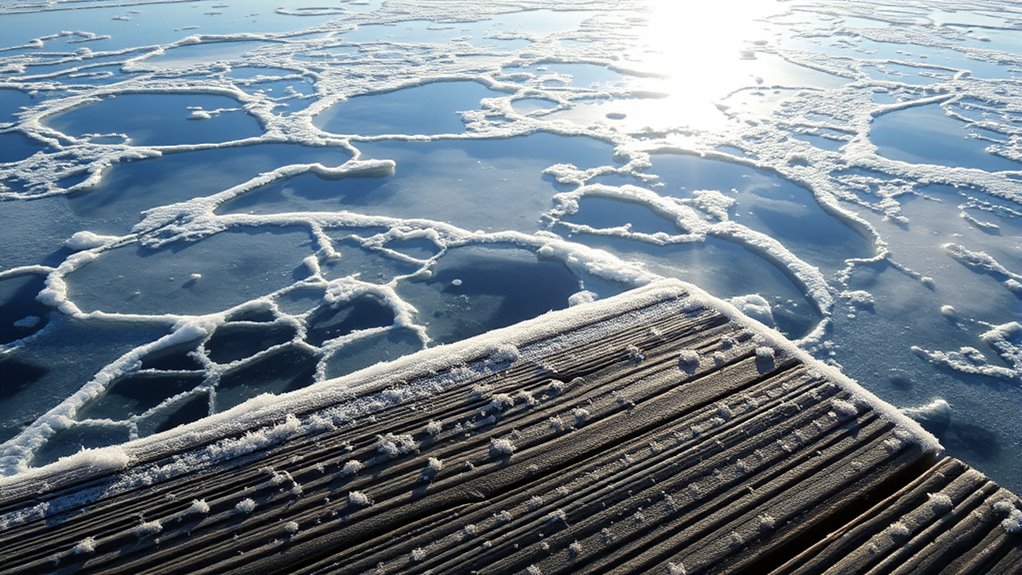
Several factors affect how long water takes to freeze. Ambient temperature plays a vital role, with colder surroundings speeding up the process. The volume of water matters too; larger amounts take longer to freeze. Container material influences heat transfer rates, with metal freezing water faster than plastic. Agitation helps distribute heat evenly, while impurities can speed up freezing by providing nucleation sites. Understanding these elements can lead to insights into optimizing freezing times.
When considering how quickly water freezes, several key factors come into play, including ambient temperature, water volume, and container material. Ambient temperature is perhaps the most vital aspect; lower temperatures accelerate freezing. As you lower the ambient temperature, the time it takes for water to freeze decreases. The freezing time is inversely proportional to the temperature difference between the water and its surroundings. Water freezes when the temperature drops below 0°C, highlighting the importance of the surrounding environment. Additionally, external temperature and environment influence freezing, as colder surroundings freeze water quicker.
Ambient temperature significantly affects how quickly water freezes, with lower temperatures leading to faster freezing times.
However, it’s essential to acknowledge that even in extremely low temperatures, water won’t freeze instantly. Pure water can supercool below 0°C before it actually freezes, a phenomenon you may encounter in controlled conditions. In typical household freezers, operating at about -18°C, small volumes can freeze in mere 1 to 2 hours.
Water volume directly influences freezing times as well. Larger volumes contain more heat energy, requiring longer durations to freeze completely. In contrast, small volumes like those found in ice cube trays freeze considerably faster. Additionally, the depth of the water matters; shallow bodies of water will typically freeze before deeper ones. This occurs because the heat dissipation rate is slower for larger volumes, meaning that doubling the volume doesn’t just double the freezing time—it often increases it even more dramatically.
Container material also affects how quickly water freezes. For instance, metal containers are excellent conductors of heat, leading to reduced freezing times. In contrast, plastic or insulating materials can slow down heat loss, prolonging the freezing process. The surface area and thermal conductivity of your container greatly influence the freezing rate. A stainless steel container will typically freeze water faster than glass or plastic due to its superior thermal properties.
The shape of the container further impacts heat transfer efficiency; flat, wide containers tend to facilitate faster freezing than tall, narrow ones.
Agitation and movement can also play a role in how quickly water freezes. Stirring the water helps distribute heat more evenly, mitigating localized warm spots that can delay freezing. While moving water doesn’t prevent it from freezing at 0°C, it promotes more uniform cooling and increases surface area exposure to cold air, which can be beneficial in industrial ice-making processes.
Impurities and dissolved substances in water can’t be overlooked. Pure water freezes at higher temperatures compared to water filled with minerals and gases. In fact, impurities can introduce nucleation sites that might speed up freezing, while distilled water tends to supercool more readily due to its purity.
Finally, the impact of air circulation and humidity is equally considerable. Enhanced air circulation accelerates heat loss, facilitating quicker freezing. On the contrary, still air serves as an insulator and slows the process down. Low humidity levels can increase evaporation, ultimately reducing the volume of water and leading to faster freeze times.
Frost layers on containers can insulate and impede effective freezing, emphasizing the intricate factors involved in this process.
Conclusion
To sum up, understanding the factors that affect how long water takes to freeze can enhance your grasp of this everyday phenomenon. Temperature plays a pivotal role, while surface area, water purity, and container type add unique nuances. You can observe that colder environments expedite freezing, larger surfaces quicken the process, and impurities slow it down. By recognizing these elements, you’ll appreciate the complexity of freezing and the science behind something as simple as ice formation.