How to Convert 750 Ml to Cups Ounces and Liters
Unlock the secrets of measuring volume as we explore the conversion of 750 mL to cups, ounces, and liters; discover why accuracy matters in your kitchen.

To convert 750 mL to cups, ounces, and liters, you can apply simple calculations. It’s about 3.17 US cups, 25.36 ounces, and 0.75 liters. To get cups, divide 750 by 237; for ounces, multiply by 0.033814; and for liters, divide by 1000. These conversions are essential for accurate measurements in cooking and baking. Want to learn more about how these conversions can impact your culinary efforts? There’s plenty more to explore!
Converting 750 mL to cups, ounces, and liters is essential for culinary precision and accurate measurements, especially when dealing with recipes or beverage servings. To effectively use 750 mL in various contexts, you’ll need to understand how these conversions work, as they can greatly impact your cooking and serving accuracy.
First, let’s explore the conversion of 750 mL to ounces. One milliliter equals approximately 0.033814 US fluid ounces. Consequently, to calculate the number of ounces in 750 mL, you simply multiply 750 by 0.033814. This results in approximately 25.36 US fluid ounces. This conversion is applicable to all types of liquids, including water, juice, and alcoholic beverages, making it versatile for various recipes or serving situations. You’ll often find 750 mL containers, such as wine bottles or large soft drink cans, making this conversion practically relevant.
Converting 750 mL to ounces yields approximately 25.36 US fluid ounces, essential for various culinary applications.
Next, you can convert 750 mL to liters, which provides another useful measure of volume. Since one liter equals 1000 milliliters, you can easily find the equivalent of 750 mL by dividing 750 by 1000. This results in an exact measurement of 0.75 liters. The cancellation of milliliters in this calculation streamlines the process, clearly isolating liters as the target unit. This straightforward conversion illustrates the importance of understanding smaller metric units. Such straightforward conversions are fundamental for scientific applications and everyday contexts alike.
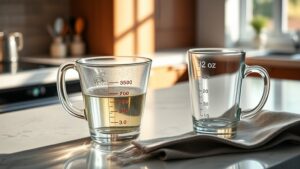
Additionally, you may want to convert 750 mL into US cups, a common measurement in culinary settings. One US cup measures approximately 236 to 237 milliliters. By dividing 750 mL by 237, you arrive at approximately 3.17 cups. Knowing how much 750 mL translates into cups is indispensable for cooking and baking, where cup measurements are frequently utilized. This volume equivalence aids in translating metric measurements into commonly used kitchen units.
Understanding the relationships between these different volume units is essential. For instance, 1 cup equals 8 US fluid ounces, which correlates with your earlier conversion of 25.36 ounces; so, 3.17 cups correspond accurately with this. You also need to keep in mind that 1 mL is equivalent to 1 cubic centimeter (cm³), and 1 US fluid ounce is about 29.5735 mL. Awareness of these relationships not only enhances your measurement accuracy but also aids in your efficiency in the kitchen.
In modern settings, accurate conversions are fundamental for successful recipe execution. Recipes often require you to convert from milliliters to cups or ounces to maintain precision in measurements. By utilizing online calculators or printed conversion charts, you can streamline the process and maintain consistency in your culinary outcomes.
As you continue to master these conversions, you’ll find that they facilitate a smoother cooking experience, enabling you to achieve the desired results with greater confidence.
Conclusion
In summary, converting 750 ml to cups, ounces, and liters is a straightforward process that can enhance your culinary precision, much like a master chef balancing flavors. Remember, 750 ml is approximately 3.17 cups, 25.4 ounces, and 0.75 liters. By understanding these conversions, you elevate your kitchen skills to that of a seasoned alchemist, transforming simple baking endeavors into culinary masterpieces. Embrace these conversions to guarantee your recipes yield the results you desire, consistently and accurately.