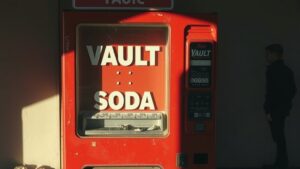
Why Did Coca-Cola Discontinue Vault Soda?
Notable for its unique flavor, Vault soda faced an untimely demise due to declining sales—discover the factors behind its discontinuation.

Coca-Cola discontinued Vault soda in 2011 primarily due to declining sales and weak customer loyalty compared to more established brands. Despite its unique blend of soda and energy drink qualities, Vault struggled in a saturated market dominated by products like Mello Yello. The vibrant color and higher carbonation didn’t translate to a dedicated following. As Coca-Cola shifted focus to top-selling items, Vault’s future faded, leading to its discontinuation. To understand more about Vault’s impact, glance further into its marketing strategies and legacy.
Coca-Cola recently confirmed the discontinuation of Vault soda, a citrus-flavored beverage launched in 2005 that aimed to capture both soda lovers and energy drink enthusiasts. Marketed as a “hybrid energy soda,” Vault targeted a diverse audience by promoting its unique benefits: it drank like a soda but provided an energy boost akin to energy drinks. With 70 mg of caffeine per serving, Vault sought to straddle the line between traditional sodas and products like Red Bull, appealing to teens and young adults craving a fizz with a kick.
Coca-Cola’s Vault soda, a hybrid energy drink launched in 2005, combined soda refreshment with energy boosts to attract a diverse audience.
The product lineup featured various flavors, starting with its original lemon-lime and expanding to options like Red Blitz, Orange, Lime, Grape, and Peach. Grape and Peach flavors were exclusive to Coke Freestyle machines, creating a sense of novelty for consumers. Though it shared a neon green color scheme reminiscent of Surge, Vault had higher carbonation levels and caffeine content, setting it apart. These features were strategically designed to entice younger consumers seeking a beverage that merged refreshment with alertness. Vault was part of a market trend for hybrid energy-drink sodas, which only heightened its competitive nature in the beverage market.
Coca-Cola invested in a robust marketing strategy to promote Vault as a game-changer in the soda and energy drink space. The campaigns emphasized its dual identity, attempting to carve out a broader niche in a competitive market dominated by brands like Pepsi and Mountain Dew. While Coca-Cola aimed to differentiate Vault by promoting its moderate caffeine content, the beverage never garnered the cult following of Surge or the success of established players. Coca-Cola promoted Vault heavily, aiming for a youth market with millions spent on advertising and sponsorships to engage this demographic.
Sales data indicated that, despite a six-year run, Vault’s popularity waned as it struggled against Mello Yello, another caffeinated citrus product. The primary reason behind Vault’s discontinuation was its declining sales performance. As Coca-Cola streamlined its brand offerings to focus on top sellers, Vault became expendable. Mello Yello’s stronger showing further solidified the decision to reallocate resources away from Vault.
Additionally, Vault’s vibrant green color may have deterred some consumers, leading to a lack of strong customer loyalty compared to better-performing brands. After its discontinuation in 2011, Vault’s presence diminished across retail shelves, although some third-party distributors and restaurant chains continued offering it via fountain services. Remarkably, Hardee’s fast food locations served Vault into the 2010s, drawing on its niche fan base.
Limited production runs surfaced for promotional events, including a tie-in with Fallout 76 in 2019, but these offerings proved short-lived. Consumer reactions included petitions to resurrect Vault, which gathered over 7,200 signatures. However, Coca-Cola has remained noncommittal about any revival plans.
Ultimately, Vault’s discontinuation underscores the challenges of maintaining a market position in a saturated beverage environment, where even innovative products can fall short of expectations and loyal followings. It’s a reminder that for every unique flavor, practical sales performance will determine a product’s lifespan in the competitive soda landscape.
Conclusion
Coca-Cola’s decision to discontinue Vault soda reflects the company’s strategic pivot toward more profitable and health-conscious beverages. While loyal fans may mourn the loss, this move isn’t just a farewell; it’s a necessary step into the evolving landscape of consumer preferences. Like a fading star, Vault had its moment, but as the night sky of soft drinks shifts, Coca-Cola aims to illuminate new opportunities. Ultimately, embracing change can pave the way for exciting future flavors.