How Much Is a Liter of Water in Standard Measurements
Learn how a liter of water translates into standard measurements and discover its significance in daily hydration choices. What other conversions might surprise you?
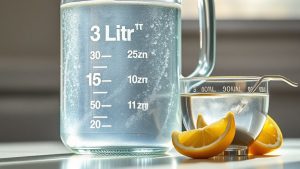
A liter of water is a metric volume equal to about 33.814 US fluid ounces or roughly 35.19 UK fluid ounces. This means it’s close to a quarter of a US gallon. If you have a standard water bottle, it typically holds around 16.9 fluid ounces, so you’ll need about two of those to make up a liter. Understanding these measurements can help you make informed choices about your daily fluid intake, so there’s more to explore!
When you think about measuring liquids, understanding how much a liter is in standard measurements can really come in handy. A liter, which you’ll often see written as L, is a metric unit of volume. It’s defined as exactly 1 cubic decimeter (dm³) or 1000 cubic centimeters (cm³). If you visualize a cube that measures 10 cm on each side, you’ll have a clear representation of a liter. This volume equivalence helps build a mental picture of how much a liter really is. Historically, the definition of a liter was based on the volume of 1 kilogram of pure water at its maximum density, around 4°C, cementing its utility in everyday life.
Understanding a liter as a metric unit of volume, equivalent to 1 cubic decimeter, simplifies liquid measurements in daily life.
When converting to US measurements, 1 liter equals approximately 33.814 US fluid ounces (fl oz). This means if you ever find yourself in need of a quick translation, you can remember that one liter corresponds to roughly a quarter of a gallon (0.264 US gallons). For a practical twist, a standard US water bottle usually holds about 16.9 fl oz, making it easy to realize that 1 liter is approximately equal to two of these bottles. Just keep in mind that fluid ounces measure volume, not mass, which can lead to some confusion. In fact, knowing that 1 liter is equivalent to 33.8 fluid ounces can simplify your hydration tracking. Importantly, drinking 2 to 4 liters of water daily is recommended based on individual needs.
If you’re curious about the imperial system, things vary slightly. One liter translates to about 35.19 UK fluid ounces, which are indeed bigger than their US counterparts. You should also take note that an imperial gallon is larger too, equal to 4.54609 liters. This shows how measurements can vary between different systems, making it essential to be aware, especially when following recipes or sharing drinks.
In the domain of smaller metric units, the relationships are also pretty straightforward. Ten deciliters (dL) make up a liter, while 100 centiliters (cL) equal one liter. Dive deeper into metric volumes, and you find that 1 dekaliter (daL) equals 10 liters, while 1 hectoliter (hL) equals 100 liters. This structured organization makes it really easy to switch between different metric volume measures.
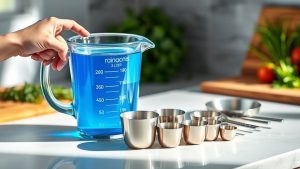
When you consider the common U.S. volume units like cups, pints, and quarts, the connections become even clearer. One pint is 2 cups, or about half a liter. Conversely, one quart, which equals 2 pints, is close to a liter at approximately 946 mL. A gallon holds around 3.785 liters, showing that liters serve as a handy metric alternative to U.S. customary volumes.
In daily life, a liter has practical implications. It fills about half of a half-gallon bottle, helping you visualize how much liquid that actually is. Whether it’s juice boxes, human stomach volume, or the volume of blood, often, volumes we encounter daily relate closely to the liter measurement. Understanding these connections helps you make more informed decisions about daily fluid intake, aligning with health recommendations and practical needs.
Having a grasp of how much a liter is in standard measurements opens up a world of understanding, making it easier to navigate everything from cooking to staying hydrated.
Conclusion
To summarize, a liter of water is equivalent to about 33.8 fluid ounces, or roughly four cups. It represents a common thread woven through our daily lives, whether you’re measuring ingredients or hydrating after a workout. Understanding these conversions isn’t just practical; it’s like knowing the heartbeat of the kitchen and beyond. With this knowledge, you’re ready to tackle various tasks with confidence, ensuring you always know how much water you’re working with.