How Many Oz in a Liter in 3 Simple Steps
Just learn how to easily convert liters to ounces in three steps, and discover a simple trick that will change your measuring game!
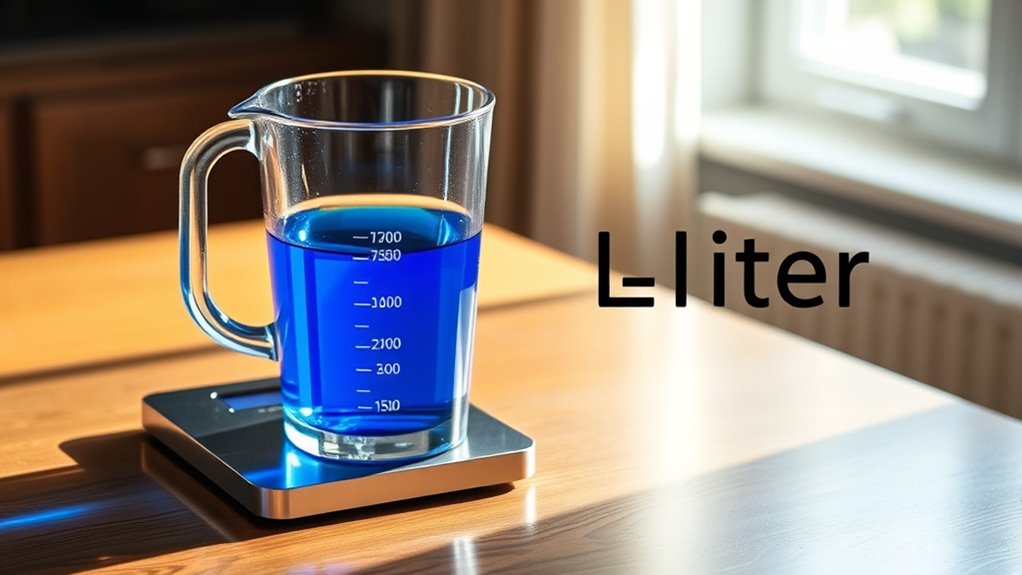
To convert liters to ounces in three simple steps, know that there are 33.814 fluid ounces in a liter. Start by taking the number of liters you want to convert. Then multiply that number by 33.814. Finally, you’ll have your result in fluid ounces. For instance, if you have 2 liters, multiply by 33.814 to get about 67.628 ounces. Keep exploring to uncover more tips and tricks on measurements!
Understanding Fluid Ounces and Liters
When it comes to measuring liquids, understanding the difference between fluid ounces and liters is essential.
Fluid ounces, abbreviated as “fl oz,” are a unit of volume in the US customary system, primarily used for liquids like water and milk. Just remember, a standard US fluid ounce equals 29.5735 milliliters. Notably, 1 fl oz = 0.02957 L helps bridge the gap between these two measurement systems.
On the other hand, liters, represented as “L,” are the metric unit for volume, which is globally recognized and equally applicable for both liquids and solids. One liter equals 1,000 milliliters.
The key takeaway? Fluid ounces are generally used in the United States, whereas liters are preferred worldwide. Knowing these distinctions can help you navigate recipes, beverage labels, and measurements efficiently.
Conversion Methods Between Ounces and Liters
Fluid ounces and liters are commonly used measurements for liquids, and knowing how to convert between them can make things easier in the kitchen or when handling beverages. To convert ounces to liters, you can use two simple methods. First, multiply the fluid ounces by 0.0295735; for example, 5 fluid ounces equals approximately 0.147868 liters. Alternatively, you can divide the ounce value by 33.814. For instance, 100 ounces divided by 33.814 gives you about 2.96 liters. Understanding the relationships between ounces and liters aids in practical applications and enhances your cooking experience. Using these methods guarantees you have quick, accurate conversions. Also, reference tables for common conversions like 16 ounces to 0.473 liters can save you time. Simply choose the method that works best for your needs, and you’ll navigate liquid measurements effortlessly.
Practical Applications for Ounce to Liter Conversions
Converting ounces to liters has practical applications in various everyday situations, making it vital for anyone who handles liquids regularly.
Here are some key scenarios where these conversions come into play:
- Cooking and baking: Guarantees accurate ingredient measurements for delicious results.
- Beverage packaging: Labels show both ounces and liters for consumer clarity and compliance.
- Pharmaceutical dosing: Ensures the right medication amounts for effective treatments.
- Household cleaning: Helps achieve proper mixing ratios for effective cleaning solutions.
- Industrial management: Maintains accurate volume tracking for chemicals and materials.
Mastering these conversions improves your efficiency and accuracy, whether you’re whipping up a recipe or managing inventory.
With these skills, you’ll navigate liquid measurements like a pro!
Common Misconceptions Surrounding Volume Measurements
Many people mistakenly equate volume with capacity, leading to confusion in everyday measurements.
Remember, volume refers to the space an object occupies, while capacity is how much a container can hold. You might think measuring water height indicates total volume, but it only shows part of the picture.
Also, don’t assume all shapes with the same volume have identical surface areas—altering the shape can change surface area without affecting volume. Misapplying linear conversions to volume is another common error, as volume scales cubically, not linearly.
Finally, mixing up length, area, and volume units can result in incorrect calculations. Understanding these distinctions will help you navigate volume measurements much more effectively.
Conclusion
Now that you’ve navigated the conversion between ounces and liters, you’re equipped to tackle any recipe or drink order with confidence. Think of it like mixing the perfect cocktail; just a splash of knowledge can elevate your experience. Remember, there are about 33.8 ounces in a liter, just as a single ingredient can transform a good drink into a great one. Embrace these conversions, and you’ll find your confidence growing—one ounce at a time!