How to Determine if Distilled Water Is Sterile
See how to accurately test distilled water for sterility and uncover the surprising truth behind its purity. What you discover may change your approach!

To determine if distilled water is sterile, you'll need to test for microorganisms since distillation doesn't guarantee complete sterility. Employ techniques like membrane filtration or direct transfer to growth media, using standard media such as Fluid Thioglycollate or Soybean-Casein Digest. Conduct these tests in a controlled environment to prevent contamination. The absence of microbial growth confirms sterility. Understanding the differences between distilled and sterile water is critical for effective application in sensitive contexts, and more insights await you ahead.
How can you be certain that the distilled water you have is actually sterile? This question is essential, especially if you're using it for medical or laboratory applications where sterility is imperative.
While distilled water is produced through distillation, a process designed to eliminate contaminants and minerals, it doesn't inherently guarantee sterility. Distillation involves boiling water and condensing the steam, but this method may not remove all microorganisms. As a result, additional sterilization methods are often necessary to confirm the absence of viable pathogens.
Distillation eliminates contaminants, but it doesn't guarantee sterility; further sterilization methods are essential to ensure pathogen-free water.
To achieve true sterility, you need to understand that it requires more than just distillation. Sterile water is specifically treated to be completely pathogen-free and must meet stringent medical standards. Common sterilization methods include autoclaving, which utilizes pressurized steam, and fine filtration, both of which are effective at eliminating microorganisms including fine filters.
It's important to realize that distilled water may still be susceptible to post-process contamination, especially if it's not handled or stored properly.
Contamination can easily occur during storage or handling. If you store distilled water in non-sterile containers or expose it to non-sterile environments, you risk introducing harmful pathogens. Thus, maintaining sterile conditions is essential, which includes utilizing sterile containers and confirming clean handling practices.
Even if your distilled water starts off sterile, improper management can compromise its safety, making it unsuitable for sensitive applications.
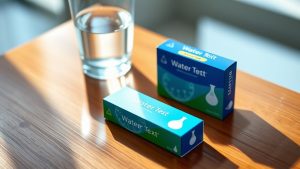
To effectively determine if your distilled water is sterile, you must conduct testing for microorganisms. This involves using methods like membrane filtration or direct transfer into growth media. Common media for sterility testing include Fluid Thioglycollate and Soybean-Casein Digest.
Performing these tests under controlled environments is critical to avoid introducing contaminants during the testing process. The absence of microbial growth in the results confirms sterility.
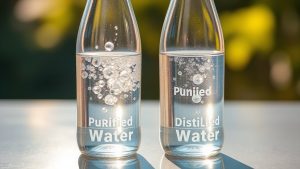
It's also important to distinguish between sterile and distilled water. While both types of water are purified, their definitions and applications differ greatly.
Distilled water is free from impurities and minerals but not necessarily free of all viable microorganisms. Sterile water, on the other hand, is defined by its total lack of viable pathogens, making it far safer for medical applications.
This distinction highlights the necessity of stringent standards for sterile water, which isn't a requirement for distilled water.
Conclusion
In summary, while distilled water is purified through the distillation process, it's not inherently sterile. To guarantee its sterility, you can use methods like boiling, filtration, or chemical treatments. Some might argue that the purification process is sufficient for most uses, but remember that certain applications—like wound care or laboratory experiments—demand strict sterility. By taking extra steps to confirm sterility, you can safeguard against potential contamination and guarantee ideal results in critical situations.