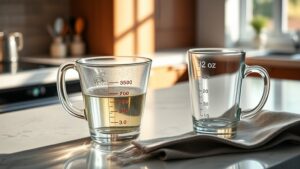
How to Convert 12 Oz to Ml Easily
Discover the simple formula to convert 12 oz to ml effortlessly and unveil the secrets behind volume conversions that everyone should know.
To convert 12 fluid ounces to milliliters, just multiply by 29.57353. So, 12 oz times 29.57353 equals about 354.88 mL. It's that simple! Remember, fluid ounces measure volume, while weight ounces measure mass, and you might need the density of the substance if you're converting weight ounces. For more tips and tricks on volume conversions, you'll want to explore further details on this topic.
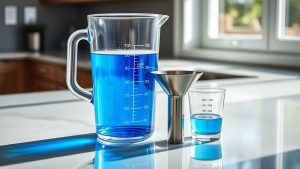
Converting 12 ounces to milliliters is a straightforward task, especially when you know you're dealing with fluid ounces. Fluid ounces are a unit of volume, making them directly convertible to milliliters without the complexity of weight conversions. The key factor here is that 1 fluid ounce equals approximately 29.57353 milliliters. To find out how many milliliters are in 12 fluid ounces, you'll simply multiply: 12 fluid ounces × 29.57353 milliliters per fluid ounce. This calculation gives you about 354.88 milliliters.
Understanding the difference between weight ounces and fluid ounces is essential for this conversion process. While fluid ounces measure volume, weight ounces can refer to the mass of a substance. Consequently, if you were converting weight ounces to milliliters, you'd need to know the density of the specific substance involved. For example, converting weight ounces of water would allow you to apply the density value of water, which is approximately 1 g/mL. Density must be in ounces per milliliter (oz/mL) for accurate results when dealing with weight ounces.
Using formulas can help simplify conversion. For fluid ounces, you rely on a straightforward multiplication formula: milliliters = fluid ounces × 29.57353. If you're converting weight ounces, the formula becomes more complex: milliliters = weight ounces × 28.3495 divided by the density of the substance. This means that for substances with different densities, you'll need to adjust your calculations accordingly.
You might find dimensional analysis a useful method for conversions. This approach allows you to set up conversion factors that help you solve problems without needing to memorize all the various conversion rates. By arranging your units correctly, you can cancel out the units you don't need, leading you directly to the answer in milliliters.
Alternatively, the proportional method can also work, although it might involve more steps to reach the final answer. If you're looking for a quick and accurate way to convert, online calculators are a great resource. They can save you time and guarantee precision, especially when dealing with less common substances or when you're unsure of the density.
For educational purposes, you might want to check out YouTube tutorials that break down the conversion process step-by-step, making it easier to grasp the underlying principles. In practice, you'll likely encounter various substances where the density differs, such as oils or food ingredients. This variability emphasizes the importance of knowing the density when converting weight ounces to milliliters.
Conclusion
In summary, converting 12 ounces to milliliters is a handy skill that can simplify your cooking and baking. Think of it like steering through a map; once you know the key landmarks, everything else falls into place. For a quick reference, 12 oz is approximately 355 ml. Just as a map guides you to your destination, mastering conversions guides you through culinary adventures. So, embrace this knowledge, and you'll find yourself confidently measuring and mixing in no time!