What Does 3 Liters Mean in Everyday Measurements?
The translation of 3 liters into everyday measurements reveals surprising insights about hydration; discover how this amount impacts your health and daily routine.
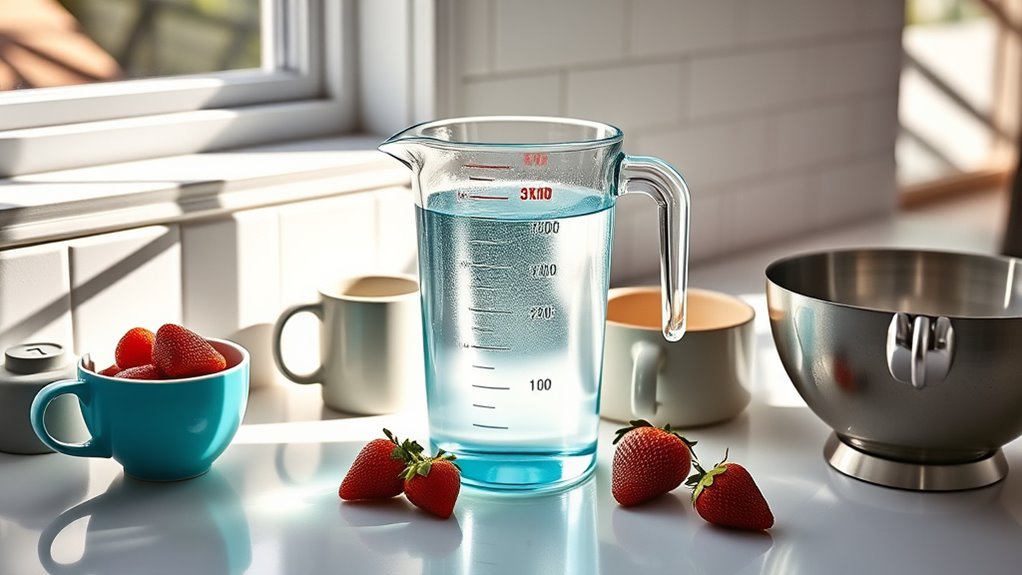
3 liters is about 100 fluid ounces, which you can visualize as five 24-ounce water bottles or three 32-ounce bottles. It’s roughly 12.7 cups and equivalent to 0.79 U.S. gallons. This amount helps meet daily hydration needs, supporting your health and performance. While staying hydrated is essential, you don’t need to drink plain water alone; other beverages and foods contribute to your fluid intake. Want to know more about hydration’s benefits?
When it comes to staying hydrated, understanding how much 3 liters really is can help you meet your daily fluid intake needs. Three liters is roughly 100 fluid ounces, a significant amount when you consider the average recommendations for daily hydration. For men, the suggested intake ranges from 3 to 3.7 liters (100 to 125 ounces), while for women, it’s typically about 2.7 liters (91 ounces), with some needing up to 3 liters. Hitting that 3-liter mark can help guarantee you’re adequately hydrated, especially considering that individual needs vary based on factors like climate, physical activity, age, and overall health.
Understanding that 3 liters equals about 100 fluid ounces can help you stay properly hydrated daily.
To visualize 3 liters, you might think about your favorite water bottles. A standard large water bottle holds anywhere from 24 to 40 ounces. If you go with a 24-ounce bottle, you’ll need about five of them to reach 3 liters. Alternatively, three 32-ounce bottles will also get you there.
Regarding household measurements, remember that 3 liters equals about 12.7 cups (since 1 cup is roughly 8 ounces), making it easier to gauge how much water you’re consuming each day. If you ever see 3-liter soda or juice bottles, these offer a straightforward comparison to help you understand just how much fluid that really is.
Drinking around 3 liters of water daily provides several health benefits. Proper hydration can help prevent kidney stones by diluting urine and reducing concentration, leading to a healthier urinary system. It can also help prevent kidney stones by diluting urine and reducing concentration, leading to a healthier urinary system. Additionally, a well-hydrated body can support overall health by regulating temperature and transporting nutrients effectively.
Staying well-hydrated can also enhance mood and cognitive function, helping you stay alert and focused. Additionally, it contributes to bowel regularity through improved digestion and softer stools, not to mention that it boosts your physical performance, especially in hot weather or during exercise.
While there’s a common guideline suggesting eight glasses of water a day, which totals about 1.9 liters, aiming for 3 liters exceeds this recommendation and is often more realistic for many adults. Most people hydrate effectively by drinking when thirsty, so hitting 3 liters mightn’t be necessary for everyone.
However, if you’re an athlete, work outdoors, or live in a hot climate, you may find that consuming 3 liters or even more becomes essential. It’s also important to note that overhydration can be risky if you’re not careful and can lead to conditions like hyponatremia.
Remember that your fluid intake doesn’t have to come solely from plain water; it can also include other beverages and moisture-rich foods. Keeping in mind that 3 liters equals about 3000 milliliters or roughly 0.79 U.S. gallons, understanding this volume can greatly improve how you manage hydration daily.
Conclusion
So, next time you think about 3 liters, picture a large water bottle filled to the brim—just like your trusty companion on a summer hike. It’s not just a number; it’s a practical volume that could quench your thirst after a long day or fuel a healthy soup for dinner. Remember, whether you’re measuring ingredients or staying hydrated, 3 liters is a handy guide, ensuring you’re always prepared for life’s delicious adventures.