What Is a TDS Water Tester and How Does It Work?
Uncover the secrets of TDS water testers and learn how they evaluate water quality—discover why this knowledge is essential for safe drinking.
A TDS water tester measures the total dissolved solids in water, indicating its quality and safety. It works by sending a small electrical current through the water, which gauges conductivity. This conductivity is then converted into TDS readings using a specific formula. Generally, a TDS level under 500 ppm is considered safe for drinking. Understanding how TDS impacts water can help you assess its suitability for various applications, and there’s more to explore on this topic.
When it comes to judging water quality, understanding Total Dissolved Solids (TDS) is crucial, and that’s where a TDS water tester comes into play. TDS encompasses all inorganic and organic substances found in water in various forms, such as ionic, molecular, or colloidal. This measurement includes essential minerals, salts, metals, and organic contaminants that considerably affect water’s conductivity. You’ll often see TDS expressed in parts per million (ppm) or milligrams per liter (mg/L). Natural sources, like minerals leached from rocks and soil, mix with anthropogenic sources, including municipal treatment chemicals and runoff from roads, contributing to TDS levels.
A TDS water tester measures the electrical conductivity of your water sample rather than analyzing the dissolved solids directly. The device emits a small electrical current through the water and gauges how well this current flows, indicating the presence of dissolved solids. To convert these conductivity measurements into TDS readings, a specific formula is applied, where TDS equals the electrical conductivity multiplied by a conversion factor ranging from 0.55 to 0.8, depending on the water’s characteristics.
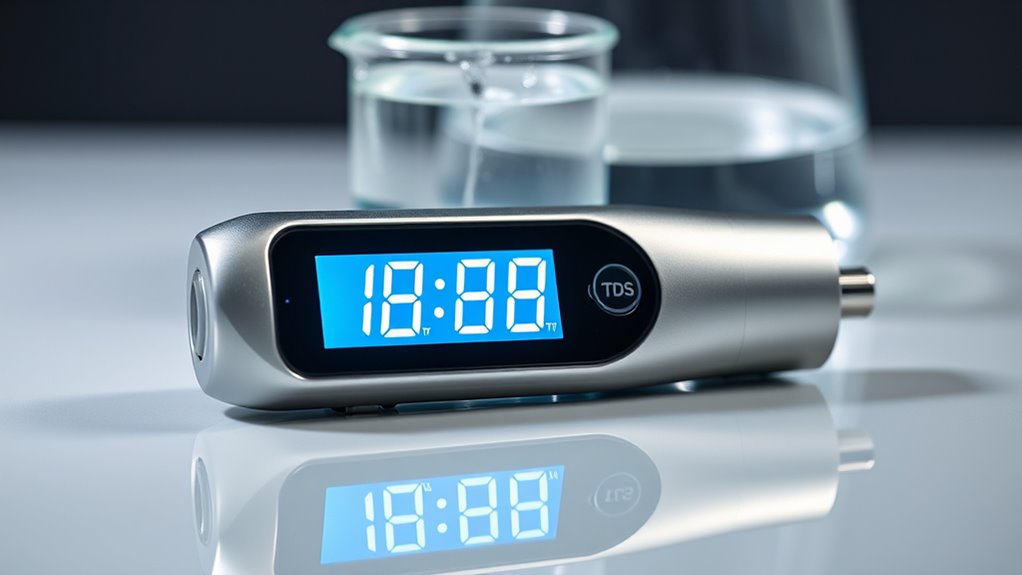
Most handheld TDS meters come equipped with a screen for easy reading, control buttons for operations, and a submerged probe that evaluates results within seconds. However, using these instruments effectively requires proper maintenance and calibration to guarantee you get accurate and reliable results.
Handheld TDS meters feature easy-to-read screens and probes for quick results, but require regular maintenance and calibration for accuracy.
When determining water safety, the EPA’s secondary drinking water regulations recommend that TDS levels shouldn’t exceed 500 ppm for safe drinking. Readings above 1,000 ppm often classify the water as unsafe, while levels exceeding 2,000 ppm may pose challenges for standard filtration systems, rendering them less effective. Conversely, a TDS reading around 100 ppm suggests acceptable drinking water quality with minimal dissolved ions present. It’s crucial to monitor TDS levels to ensure they remain within recommended limits for various water sources and uses.
It’s important to note that higher TDS might correlate with lower Langelier Saturation Index values, impacting overall water chemistry balance. Using a TDS tester serves a pivotal role in gauging water quality in various environments such as streams, rivers, and lakes.
Technicians frequently use these measurements in areas with unsafe tap water systems to evaluate the effectiveness of reverse osmosis and other filtration methods. TDS readings offer an indirect evaluation of filter performance by highlighting the presence of dissolved solids, though they fall short in identifying specific microorganisms. Water quality professionals typically employ TDS tests as a standard part of their assessment protocols, helping to identify concentrations of dissolved salts or chemicals that could stem from agricultural runoff contamination.
However, it’s critical to recognize the limitations of TDS meters. While they can provide a quick snapshot of water quality, they don’t specify which types of dissolved solids are present. Consequently, they can’t offer a thorough analysis of water quality, particularly concerning microorganism presence.
As you consider investing in a TDS water tester, keep in mind its utility as an initial screening tool rather than an all-encompassing evaluation device for water quality.
Conclusion
In the domain of water quality, a TDS water tester is your trusty flashlight, illuminating the invisible impurities lurking in your drinking water. By measuring the total dissolved solids, it empowers you to guarantee your water remains clean and safe. With a simple dip and read, you gain valuable insights into your water’s purity. Don’t underestimate this tool; staying informed about your water quality is vital for health and well-being. Use it regularly to keep your hydration crystal clear.