How Much Is 64 Oz in Gallons Liters and Cups
In this guide, discover the fascinating conversions of 64 oz into gallons, liters, and cups, and uncover surprising everyday uses. What else could this measurement reveal?
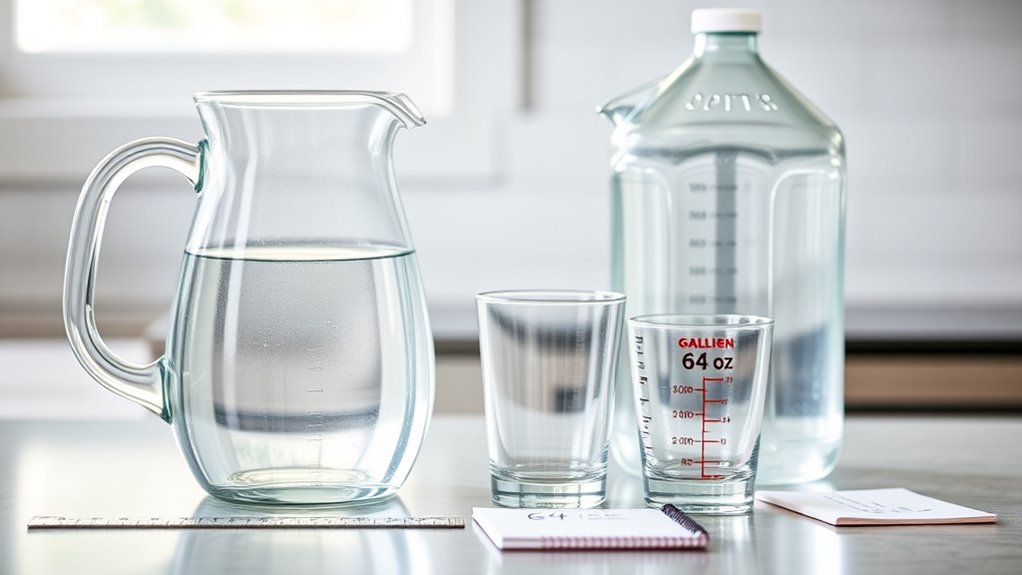
64 fluid ounces equals half a gallon, which is 0.5 gallons. When you convert it to liters, you get approximately 1.89 liters. Regarding cups, 64 ounces translates to 8 standard US cups since one cup is 8 ounces. This measurement is common for many beverages, making it easy to understand in daily use. If you’re curious about more conversions or details, there’s plenty more to discover.
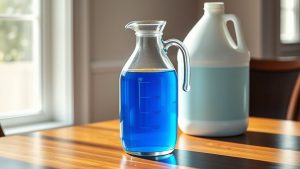
Have you ever wondered how much 64 ounces actually is regarding gallons, liters, and cups? Let’s break it down. When you encounter 64 fluid ounces, you’re looking at exactly half a gallon. To convert fluid ounces to gallons, you simply divide by 128, since one US gallon contains 128 fluid ounces. So, 64 divided by 128 gives you 0.5 gallons, or a half gallon. This is a common measurement for various containers, like a standard half-gallon milk jug.
Now, let’s look at the conversion to liters. If you’re working in metric measurements, 64 US fluid ounces converts to approximately 1.893 liters. To arrive at this figure, you start from the gallon conversion: since one US gallon equals about 3.785 liters, you can calculate it by multiplying 0.5 gallons by 3.785. This results in approximately 1.8925 liters, which you can round off to 1.89 liters for simplicity. Remember, a liter contains roughly 33.814 fluid ounces, making this calculation crucial for those needing to switch between measurement systems.
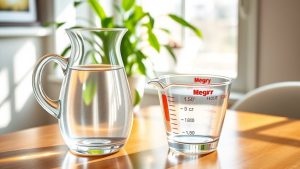
Next, if you’re curious about cups, you’ll find that 64 fluid ounces equals 8 standard US cups. Since one US cup contains 8 fluid ounces, dividing 64 by 8 confirms that you get 8 cups from 64 ounces. This equivalence makes it easy to visualize portions when cooking or serving beverages. You’ll see that a pitcher or large jug often holds about this amount, making it a practical measurement in kitchens and picnics alike.
It’s important to note that US fluid ounces measure liquid volume, distinct from weight. This differentiation comes into play when using various measurement systems, as the Imperial (UK) system utilizes different standards. The US gallon standardization remains consistent at 128 fluid ounces per gallon, allowing for straightforward conversions within the US system. Additionally, large quantities can be organized into manageable conversions to facilitate cooking and beverage preparation. Importantly, one gallon is equal to four quarts, eight pints, or sixteen cups, which further highlights the versatility of this unit.
In comparison, a cubic meter equals 33,814.023 US fluid ounces, showcasing how volume measurements can scale up in larger units.
In everyday scenarios, you’ll find 64 ounces are common in beverage sizes, such as a standard half-gallon milk container or an oversized water bottle. If you’re thinking about recipes, 64 ounces often serves as a baseline liquid measurement. This is particularly useful for cooking or beverage preparation, where accuracy is key.
When dealing with conversions, recognizing patterns can simplify the process. For instance, if you multiply 0.5 gallons by 128, you convert back to 64 ounces. Alternatively, dividing any fluid ounce measurement by 128 gives you the gallon equivalent. If you’re examining larger amounts, remember that 256 fluid ounces equals 2 gallons, while 32 fluid ounces equals 1 quart or 0.25 gallons.
Armed with this knowledge, you’re now better equipped to deal with fluid ounce measurements in various contexts, whether for cooking, nutrition, or simply satisfying your curiosity!
Conclusion
To sum up, converting 64 ounces is straightforward: it’s equal to 0.5 gallons, about 1.89 liters, and 8 cups. Understanding these measurements is essential, whether you’re cooking, baking, or tracking your hydration. So, when it comes to measurements, don’t get lost in the weeds—knowing these conversions can save you a lot of time and hassle in the kitchen. Keep these figures handy, and you’ll always be ready to whip up a delicious recipe without missing a beat.